
|
|
||
|
|
||
|
ABOUT US EIS PROCESS LEGAL PROCESS RAIL'S PROBLEMS ALTERNATIVES TO RAIL RESEARCH Links Cliff's op/eds ARCHIVES PREVIOUS MONTHS
|
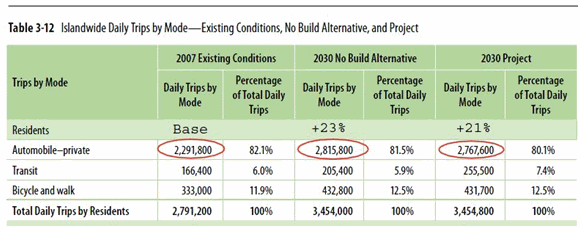
Here's another way to look at the absurdity of rail: This table below is from the Final EIS. Calculate the increase in automobile trips with the rail project compared to "Existing Conditions" and you get a 21 percent increase. The increase under the "No-Build" projection, that is if we do nothing, is 23 percent (nobody is suggesting we do nothing). In short, we get 21 percent more autos on the road with rail and 23 percent without it. Some benefit for $5.2 billion (and counting).
Prelude to the Un-Done Deal: There have been a number of over-the-top statements made recently about how the rail project cannot be stopped. Sen. Inouye said that only World War III could stop it and Mayor Carlisle has said that rail is on its way and it is a genie that cannot be put back in the bottle. These are merely more of the “Relax folks, stop thinking or acting, this is a done deal.” Actually, those occasional clicking sounds you hear in the background are the dominos, slowly toppling one by one as they gain momentum and rail turns into the Un-Done Deal.. As we explained to the City Budget Committee on Thursday (Special Budget A video, starting 1hr. 7 mins. & 1hr. 52 mins.), the Council is taking a big risk by continuing to spend taxpayer money when the obstacles facing the rail project are so huge. Any one of the following will stop rail dead in its tracks, so to speak: First, Ben Cayetano wins the Mayoral race on August 11 this year with more than 50 percent of the votes. Last Thursday Governor Abercrombie made it clear that this race will be a referendum on the future of rail so that means both the Mayor and Governor will be opposed to this rail project. FTA has always said they need to have strong local political support if they are to fund rail. Without the support of the Mayor and Governor, rail is dead. Second, on August 21, ten days after the Mayoral election results, Federal Judge Wallace S. Tashima will hear the final motions on our lawsuit, Honolulutraffic.com et al, vs. FTA and the City. He will rule on this matter shortly thereafter. The cornerstone of this lawsuit is a statute passed in 1966 to inhibit federally funded transportation projects that negatively affect historic properties including burial sites. Since Congress passed it to prevent exactly this kind of destructive project, our attorneys expect to prevail. A new project must avoid the use, even constructive use, of historic properties. Third, Congress is not likely to approve federal rail transit funding in time. Transportation Issues Daily says, “The Senate and House may pass most or all of the FY 2013 appropriations bills, but it is very unlikely final spending bills will be reconciled and approved until after the November elections.” If Republicans have a stronger hand after this year’s elections, rail transit projects without approved Full Funding Grant Agreements in place, such as Honolulu’s, can expect minimal funding. Again, any one of these events kills rail; we expect all three. So much for World War III . And as for the genie, what will not go back in the bottle is the public’s realization now that a) traffic congestion will be worse with rail, b) there will be no energy savings, c) rail will not be faster than TheBus, and d) there would only be hundreds of short-term jobs, not thousands. Those myths are now so exploded they are never going back in the bottle.
Chinatown station — talk about urban sprawl: This drawing is from the HART website and is their engineering drawing of the Chinatown station (page 44/85). Using the right hand lane height from ground level to the underside of the rail structure of 18' 1" (as shown) we can calculate that the Chinatown Station will be approximately 56 feet high by 203 feet wide. From the same document but page 42 of 85, we can similarly calculate a length of 253 feet. Any structure of 253 feet long by 203 feet wide by 56 feet high sprawling over the city waterfront is urban sprawl.
A typical cross section of rail and traffic:
The elevated rail line to the right of the drawing depicts the provision of a secondary rail line, which is the "planned extensions" to UH and Waikiki to go over the structures along Kona Street that are part of Ala Moana Center. Note that it is a single line, which raises questions about the frequency of service to UH and Waikiki when there is only a single line to service both of them. This is a "straddle bent" support (see photo at our May 1 entry below) used when a center line supporting pillar is not practical; it uses smaller supporting pillars on each side with a cross beam between them. Also note the approximately 3½-foot high sound barriers on the outer edges of the rail line. These are to reduce the sound level of the train, a problem which up to now we were told did not exist. The space between the trains allows space for an emergency walkway for use when power failures occur. However, the walkway is not at the level of train egress and so one has to wonder how wheelchairs will be dealt with.
The HART website is misleading despite claims of transparency: Let's start with the HART's Q&A section where they pose a question and answer it themselves. Here's one: City Q & A: Is rail transit going to make a difference in traffic congestion? Yes. By 2030, unless we have rail, there will be an estimated 40,000 more car trips per day on Honolulu's highways and surface streets. Rail will remove these cars and reduce delay due to congestion by 18 percent. Our Response: That sounds good. However, Table 3-12 in the Final EIS (see the May 4 entry below) shows that if the City doesn’t build rail, population growth would add 525,000 cars to the road. If it does build rail, population growth less the minor effect from rail, would still add 476,000 cars to the road. So, in round numbers, it means we would have a half million more car trips every day whether we build rail or not ! Some benefit for spending $5.2 billion (and counting).
Are the local construction jobs really going to run into the thousands?
The adjacent table is courtesy of a recent Hawaii Star-Advertiser article. It looks to us that HART has "generated" 152 local construction jobs out of the total of 508 jobs so far. Since we always parse the City's sentences we have to note the word "generated" as being different from the simple "hired." Does it mean they intend to hire or they have actually already hired? With the new transparency promised by Mr. Grabauskas we are sure that we will shortly be enlightened as to what it actually means. City transparency in the past has simply meant that we could see through all their attempts to mislead us.
Rail's federal funding is slowly fading away: Today's Transportation Issues Daily, in an article titled, "Two Reasons the Back-Up Plan for a Transportation Bill Probably Won’t Work," forecasts that a) other than short term extensions of the last Transportation Bill, SAFETEA-LU, there will be no new bill this year, and b) there will be even worse squabbling over any new bill in an even more partisan post-election Congress. For Honolulu, this means that the $250 million that the Obama Administration had set aside for our rail project will just disappear. It also means that New Starts Funding as a national program may also disappear.
Join the Honolulutraffic.com REDACTED Club: Eligible members are those who submitted emails or letters concerning the rail project to either the City or the FTA and the subsequent official comments were found to be REDACTED in the Administrative Record. These are the first fourteen proud members of the REDACTED Club: Ben Ramelb, Bobbie Slater, Panos Prevedouros, Sid Char, Lawson Teshima, Mike Dang, Sally Hall, Nicholas Bleeker, Jamie Story Nancy Nagamine, Pearl Johnson, Dale Evans, Rich Ubersax and Cliff Slater. To check whether you qualify for membership in this exclusive organization, enter the following in a Google window --- redacted fta "yourfirstname yourlastname" --- and that should bring up any items in the Administrative Record where your name is mentioned. All these documents are pdf files that have a number that starts with AR000 and has ten alphanumeric characters. The original thread must be from you and not just appear on, say, their enemies' list. Send us the AR number and your name to become a member. In addition, to be inducted into the REDACTED Hall of Fame you must have a thread with at least five redactions.
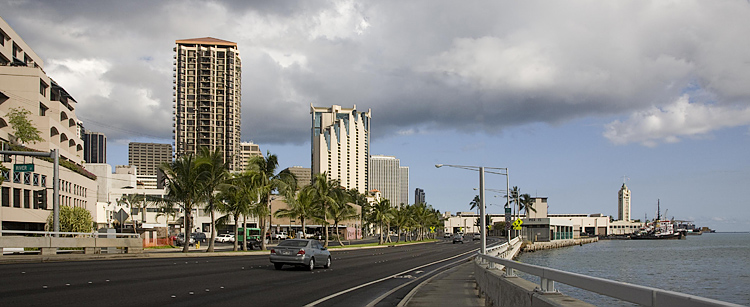
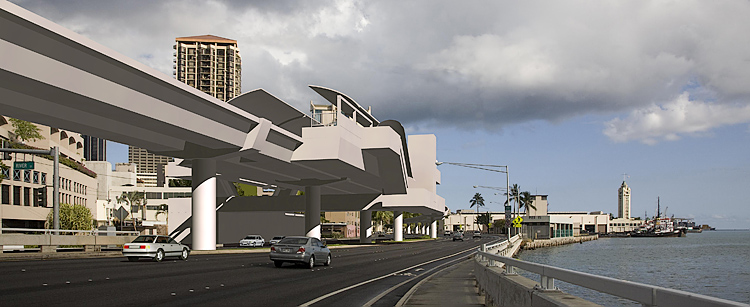
Rail renderings are not to scale: The photo below with a rendering of the rail infrastructure imposed on it may be found in the Final EIS, page 4-89. It is the City's effort to depict the visual impact of rail at the Halekauwila Street/Cooke Street Intersection, looking Mauka past Mother Waldron Neighborhood Park. Note the supporting pillars just behind the parked cars and about 120 feet further behind another pillar. These pillars are supposedly eight feet in diameter. However, if you allow that this car is a Toyota Camry with a length of 15' 9" then if the pillar were to scale it would measure less than three feet in diameter. There's one thing you can say about HART's new transparency program; you can see right through it. And you thought that the FTA approved the Final EIS.
Randal O'Toole's "Designed to Fail" is a must read: This is an article that you need to read for more ammunition. Here are the first three paragraphs; after that he really gets in gear: "Are American cities competing to see which can come up with the most ridiculous transit proposals? If so, Honolulu will probably win, hands down. The nation’s 52nd-largest urban area has only about 950,000 people, yet it is spending $5.3 billion, or more than $5,500 per resident, to build a single 20-mile rail line. That’s probably a greater cost per person than any rail system ever built–and it is just for one line, not a complete system. "The line will be entirely elevated, yet they plan to run just two-car trains, each “train” being about the length of a typical light-rail car (just under 100 feet). This means it will have the high costs of heavy rail and the capacity limits of light rail. "One of the many deceptive claims about the project is that it is “high-capacity transit.” In fact, the two-car trains were planned to have only 64 seats. The city says it will ask the railcar builder to increase this to 76 seats, a change order that will no doubt add to the cost. As the Antiplanner’s colleague, Wendell Cox, says, “the number of seats is the least of their problems."
Hooray! 40,000 cars would be taken off our roads. Really? Yes, the City data show a 48,200 reduction in automobile trips from what it might be without rail (2030 No-Build versus 2030 Rail Project). But the City data also show that population growth will be adding 476,000 cars to the road through population growth. That’s the City’s number, not ours. In other words, if the City doesn’t build rail, population growth would add 525,000 cars to the road. If it does build rail population growth, less a minor effect from rail, would add 476,000 cars to the road. So, in round numbers, it means we would have, a half million more car trips every day whether we build rail or not ! Some result for spending $5.2 billion (and counting).
Media discuss the debate: Hawaii Reporter's Jim Dooley covers the Chamber of Commerce debate between Cayetano, Carlisle and Caldwell in an article titled, Cayetano Calls Dan Inouye "Out Of Touch" in Mayoral Debate. Courtesy of Hawaii Reporter here are the times that broadcasts of the Chamber of Commerce debate can be seen:
Dan Boylan's Island Insights program on Public TV yesterday had a discussion with prominent local media figures on the closing of the Legislature and other current matters, which included an interesting seven minutes of discussion on the mayoral race and the debate. That part of the program starts at the 42:30 minute mark (just roll your cursor over the line and drag the marker to that point). Particularly interesting was Borreca's comment, made twice, that rail proponents failed to present a coherent case for rail and that Cayetano's case against rail was far stronger.
Richard Borreca discusses the 8-round Cayetano vs. Carlisle/Caldwell fight: In Borreca's Star Advertiser column today, he sounds like he thought that the referee should have ended it at the end of the first round. Here are a few paragraphs as a teaser: "Cayetano’s tactics were tough enough that at the end of the debate, when the three were given a free two-minute period to ask questions of their opponents, Caldwell folded and said he didn’t have any more questions to ask. “I’m hungry, I bet you guys are, too; I’m OK, I enjoyed the back and forth,” Caldwell said. "Neither Caldwell nor Carlisle, during any of their question periods, asked Cayetano to spell out his alternatives to the rail project or questioned why he purposely said the $5.3 billion rail project would cost $7 billion. But, to run out of questions in a political debate is like the matador, walking away from a still-living bull, telling him, “Well, I enjoyed that. Have a nice day.” "Cayetano, however, had plenty more questions, asking Caldwell to explain what he would do as mayor if the rail was partially built and then ran out of money. Caldwell said he already answered that question; Cayetano rephrased it; Caldwell said he would call for a public referendum, adding, “I already answered your question — if you don't like it, I will give you the same answer.” Cayetano dismissively shot back, “I don't know if they will like the answer, but I think they can figure you out.”"
Jay Fidell describes the outcome of the media review of rail coverage: Last week, ThinkTech Hawaii and the Hawaii Venture Capital Association put on a two panel review of media coverage of the rail project with the panels consisting largely of current media professionals. ThinkTech's President Jay Fidell released a review of the proceedings; it is well worth reading. Here are a few concluding paragraphs: "If the press can’t get this information, we don’t get it. If it is manipulated, we are manipulated. In these days of joylessness about the economy and public finances, we rely on the press to dig deep, find the truth, report all the news and, in so doing, protect us from wasteful or ill-advised public projects. "Construction has started, but what a kettle of fish: a public that is completely polarized; a $6 billion project in deepening controversy; a lawsuit; a mandate election with a candidate sworn to deep-six the project; and a frustrated press that has been denied access to primary sources. Thank you, Messrs Mayor. "This divisiveness didn’t have to happen. It reflects unacceptable strategies by two successive administrations, and we’re suffering for that. As Ian Lind said, “The lack of transparency here wasn’t the problem; it was the plan.” We need to learn by what has happened and insist on total transparency from now on. "Rail is what it is and we are where we are. Now that construction has started, we need to examine the realities and look for rapprochement before it tears us apart. But whatever happens on rail, we have to think twice before voting for anyone who has played the press, misled the public or abused our trust."
The Washington DC airport rail extension: Our Washington correspondent sent us this photo taken today of construction of the 23-mile Dulles Airport extension. The interesting thing about the Dulles Metrorail extension is not the cost overruns, delays, or construction caused traffic delays. It is that a good part of the payment for this rail line is being paid for by tolls on autos. No one in DC seems to consider that the tolls might be used to build roads since that is where the need is. Anyway, our correspondent tells us that he measured the supporting pillars of what are known as straddle bent supports, of which there will be a significant number built for the Honolulu rail line. The vertical supports are 8 feet square and the straddle bent itself is about 12 feet at the top. Were we ever to build the rail project in Honolulu, the Dulles extension gives us a good idea of what it will look like.
And now, finally out of hiding, the suits come to the rescue of TheTrain: We have not heard a peep out of the suits up to now. But one crack of the whip from Ringmaster Dan and they all jump to their appointed places to await the talking points memo, which assumedly will arrive shortly. This is so reminiscent of the 1995 "Thumbs Up, Hawaii" campaign that Hawaiithreads.com rates as one of the worst ad campaigns of all time. They said, "What this campaign tried to do was whitewash Hawaii's bad business image by painting a false and rosey picture that this was a great place to do business and a great time (circa 1995) for you to spend your hard earned money on big ticket items." The problem that the suits and Sharon Weiner, their PR group, face is that now that people have figured out that a) traffic congestion will be worse in the future with rail, and b) the train is less energy efficient than our buses, and c) taking into account total costs, rail is far more expensive than buses, and d) we cannot afford it, then that is a genie they are not going to be able to stuff back into the bottle. If they couldn't fool the public in 1995, before the Internet, before Facebook, before Twitter, they sure as hell are not going to be able to do it now.
Cynthia Oi detects the "scent of condescension": Cynthia's column this week in the Star Advertiser with the title, "Business chiefs try to ride to the rescue of rail," takes aim at the Move Oahu Forward group. Here's a few paragraphs: "Oversensitive types might take offense that a new group of business chiefs in Hawaii presumes “to educate the residents of Oahu” about the benefits of the city’s rail project." "Move Oahu Forward’s mission statement imagines that residents remain uninformed about the $5.27 billion project and that those who oppose it or fear it will cost too much to build and maintain merely need to be schooled." "Even having ventilated the scent of condescension wafting from the group’s announcement last week, its effort will likely add to the conflict over rail because no one — not even the esteemed U.S. senator who has declared that only a third world war will stop this train from running — can say with any certainty how well or how badly the project will affect Oahu."
Here's some questions for the media to ask: The latest news reports prompt us to ask why the media has not asked the following questions:
Unspeakable arrogance and Hawaii's environmental laws: What is being lost in the discussion about whether to grant the County Mayors and the Governor the ability to override environmental law, and environmental impact statements (SB 755 SD2 HD3), is that these laws were passed primarily to restrain politicians from being reckless with public resources, not to restrain the private sector. For example, there is little that a private developer can do that does not involve the use, directly or indirectly, of public resources. Accordingly, the private developer will always need political permission to develop virtually any project. Hence, gaining that permission is a cost, direct and indirect, of doing business as a developer. And relative to the potential benefits to developers, politicians generally come cheap. The indiscriminate and virtually unconstrained private/political partnership constructing freeways into cities in the late 1950s and early 1960s caused a huge public outcry nationally. That led to Congress passing in 1966 many environmental statutes such as the one known as Section 4(f). This statute essentially requires federal transportation agencies to only approve transportation projects, such as freeways and rail lines, that had been rigorously investigated for potential alternatives that might avoid the use of a city’s historic and recreational resources. Public insistence led to similar environmental protections being enacted into law by the various states, including Hawaii, whose environmental statutes cover much of the same ground as the federal statutes. In short, environmental laws, certainly as they relate to construction projects, were passed to prevent politicians from using public resources without adequate consideration of the environmental consequences. Thus, what a majority of our state legislators are attempting to do is essentially rescind our environmental laws, unless it is convenient for them to invoke them. To pass such legislation would be an act of unspeakable arrogance; these legislators must be stopped.
Reminder: TheBus uses half the energy that rail would use: Just a reminder: If your primary concern is to use the most energy efficient means for urban transportation, and particularly commuting, then rail should not be your choice. We have shown that if fuel efficiency is a concern then the solution for Honolulu is clearly buses, or even better, van pools. Federal data show that TheBus is one of the most fuel efficient in the country with energy use per passenger mile -- half that of the U.S. average for buses. Van pools are even more efficient and while good data on this issue is hard to come by, vanpools run one way into town with normally a full load and do not make a return trip empty as so many pubic transportation vehicles do. It would not be surprising to find that vanpools have half the energy usage per passenger mile of buses. Read http://www.honolulutraffic.com/HNL_rail_energy_use.pdf
London Underground offers better seating: As can be seen from the photo below, sent to us by our London Correspondent, the ratio of standing to seating is better on the London Underground. However, the cost is far greater. As can be verified on the Transport for London website, the fare from Ruislip to South Kensington is $7.00 during the rush hour for the 14.0-mile trip. The monthly pass at $305 does not seem to save you very much. Compare that with what is projected for Honolulu: $2.50 single fare and $60 for a monthly pass. Since the London Underground loses money, that should make you think about what TheRail would lose.
Court schedule for resolution of Honolulutraffic.com, et al. vs. City & FTA: April 6 – Plaintiffs to file opening motions for summary judgment (MSJ). May 18 – Federal and City Defendants to file separate cross-motions for summary judgment. June 8 – Plaintiffs to file further support for their MSJ. June 29 – Federal and City Defendants to file reply briefs in support of their MSJ. August 21 – Hearing on resolution of cross motions for summary judgment. This is the link to the actual language of the Court's Orders.
Our Motion for Summary Judgment was filed yesterday: Our attorneys filed a Motion for Summary Judgment in Federal Court yesterday. The Motion, together with its supporting Memorandum, three Exhibits and three Attachments are all listed under the 'Legal Process Docs' tab to the left.
Administrative Record now online: The 43.5 gigabyte Administrative Record is now on line at Honolulutraffic.com in two ways. First, on March 26 this year we launched it in way that could not be searched but would enable researchers who had the document AR number to download it. This would ensure that researchers could determine whether or note anyone quoting from the Record was doing so without taking the quote out of context. (see March 26 entry below) Second, the search crawlers have been working over the material and much of it is now online and searchable. We suggest that when searching you confine yourself to the Honolulutraffic.com website either by using the radio button under the Google search window above, or by entering the phrase "site:www.honolulutraffic.com" in the search window together with your search parameters. Thus, "site:www.honolulutraffic.com Cayetano" would result in any mention of anyone by the name of Cayetano in our website and much of it will be from the Record, which can be easily identified as having a document name beginning AR00 followed by six more numbers and the pdf file type, e.g. AR00123456.pdf.
Federal funding for rail project dimming: Today's Transportation Issues Daily tells us, "With just two days to spare before SAFETEA-LU expires, the House passed a 90-day extension of the legislation by a 266-158 vote. The Senate passed the bill shortly thereafter by voice vote. The White House had already signaled it would accept and sign the extension. This ninth extension of T-LU will expire on June 30." In a separate analysis they also detail why the Transportation Bill is unlikely to result in a bill that would contain New Starts funding sufficient for the FTA to enter into a Full Funding Grant Agreement with the City Administration. The summarize as follows: "The bottom line: Assuming the House passes a bill, there’s still a slim chance a multi-year bill can be passed this year. But odds are very high that Senate-House negotiations – if it even gets that far – will not succeed and SAFETEA-LU will be extended into November/December (or perhaps the spring of 2013)." What it all means, in a nutshell, is that federal funding for the Honolulu rail project is getting slimmer and slimmer. IF the Transportation Bill does get put off until after the end of the year, and IF the upcoming elections lead to a stronger Tea Party in the House and IF the Republicans take the Senate, there will be no rail funding. As the radio people say, stay tuned.
It's April Fools Day, folks: But today should not seem different for everyone who follows the rail project since the City is are trying to fool us every day of the year anyway. Here's an example: The Mayor keeps telling us that rail will take 40,000 cars off the road. Man that's a lot of cars; that should help free up the traffic. But here's the rest of the story: Yes, if the City's forecasts are right, rail transit will reduce car trips by 40,000 daily — actually 48,000 if I may correct the Mayor. It is 24,000 round trips. That sounds like a huge amount but it only reduces the number of cars on the road in the rush hour period by 1.7 percent from what it would be if we did nothing and no one is suggesting doing nothing. And all this is using the City's numbers not the likely ones.
Hawaii Reporter covers the Cayetano Show at SBH breakfast: Each month Smart (fka Small) Business Hawaii holds a breakfast for its members for networking and hearing interesting speakers. This month it was former Governor Cayetano who set a record standing room only attendance for SBH breakfasts. The Hawaii Reporter story about it is titled, 'Former Gov. Cayetano Accuses Rail Authority Board of 'Malfeasance.' Here are the first few paragraphs: “Former Gov. Benjamin Cayetano said Thursday the city's Honolulu Authority for Rapid Transportation Board of Directors, who were appointed to oversee the construction and maintenance of the city's $5.3 billion planned 20-mile elevated steel on steel rail system, "had better get a lawyer if he is elected mayor" this fall, "because he will go after them for malfeasance." “HART's 10-member volunteer board is approving contract awards for more money than they've collected from city taxpayers, Cayetano said, and before they know whether the city will be issued a Full Funding Grant Agreement by the federal government for $1.55 billion. "The way the rail project is structured, HART should have the whole thing (amount of money) before they start construction on the rail project," Cayetano said. "They acted irresponsibly - they should be held accountable." “If Cayetano beats former city managing director Kirk Caldwell and Honolulu Mayor Peter Carlisle in the upcoming 2012 mayoral election - both Carlisle and Caldwell support the rail - Cayetano said he will find a way to impose sanctions on the HART board members.” Read the whole thing.
Shapiro lays it on the line: On Wednesday David Shapiro's Volcanic Ash column discussed further how the City continues to try to mislead us. Here's a couple of paragraphs from it: "City transit officials make it sound like natural inflationary forces are the reason rail costs would go up by $10 million a month if they wait for approval of $1.55 billion in federal funds before starting heavy construction of the $5.27 billion Oahu commuter train. "Actually, it's the result of their unrealistic and politically driven timetable that ignored the advice of the Federal Transit Administration and set an earlier construction start than federal reviewers thought possible."
Error correction for August Court date: We had earlier said that the court date to hear the final cross motions on summary judgment as August 20th. The correct date and time for August 21, 2012, at 10:00 AM in the PJKK Courthouse in Honolulu.
Judge sets date for final Motion on Summary Judgment: Today, Judge Wallace Tashima issued an order setting the court date to hear the final cross motions on summary judgment as August 20th, 2012, in Honolulu. Further he ordered the FTA to produce its Privilege Log for the Administrative Record to determine if the documents the FTA had omitted from the Record were justified. A further hearing will be held in Honolulu on April 18 to hear motions regarding the standing of certain plaintiffs and whether certain 4(f) issues can be heard.
Roth, Heen & Slater letter to the Federal Transit Administration: Today, Professor Randal Roth, Judge Walter Heen and businessman Cliff Slater sent a letter to the FTA enumerating the problems facing the rail project, not the least of which is lack of public support. They conclude with the following two paragraphs: "Finally, we have concerns about the FTA's role in all this. For example, we wonder if you realize that City officials and HART board members, when pressed on the wisdom of continuing to spend hundreds of millions on construction that will probably be torn down in the not-too-distance future, regularly point to your agency. They say or imply that the FTA would put a stop to what they are doing if their decisionmaking and numbers were not rock solid. They claim to be doing absolutely everything, "by the book," and for that reason to have the FTA's blessing. "We also wonder about the FTA's amazingly quick reaction to Gov. Cayetano's release of emails in which FTA personnel express concern about various aspects of the rail project. Ignoring for now the question of whether the FTA should allow itself to get sucked in to a political campaign, we were troubled by the following statement in the FTA's press release: "The Federal Transit Administration believes that this project will bring much needed relief from the suffocating congestion on the H-l Freeway." We believe that this is inconsistent with the FTA's earlier judgment as expressed in its Record of Decision for the Project, in which it wrote, "Many commenters [on the Draft EIS] reiterated their concern that the Project will not relieve highway congestion in Honolulu. FTA agrees, but the purpose of the Project is to provide an alternative to the use of congested highways for many travelers. It is also inconsistent with the FTA approved Final EIS in which the City wrote, "You are correct in pointing out that traffic congestion will be worse in the future with rail than what it is today without rail, and that is supported by data included in the Final EIS."
Federal funding getting even more doubtful: Here are a the first few paragraphs from Transportation Daily's weekly briefing: “As you learned from our last issue, Congress last week turned its (transportation) attention to drafting an extension of federal transportation programs instead of passing a multi-year bill. We were also in the ballpark with our prediction of a two- or three-month extension “Congress is expected to pass a three month extension of SAFETEA-LU [T-LU] this week, before breaking for a two-week Easter break for members to work in their state/district. T-LU is scheduled to expire at midnight on March 31. See our story "Federal Transportation Programs, Funding to be Extended This Week.” “This Week in Congress: The House will take up and should pass the T-LU extension early in the week. The Senate is expected to pass the bill later in the week. "The House will debate and pass its 2013 budget resolution, which is the blueprint for the appropriations committees to craft the year's spending bills. FY 2013 begins on October 1, 2012. See our story, "House GOP Proposes 36 Percent Cut to Transportation Funding." You may get further information by following the links above.
Administrative Record now online: We have had comments that the quotes used from the Administrative Record were taken out of context. In order to show that this has not been the case, we are putting the complete Administrative Record on line so that you may find the actual document by using its Document number, which starts with AR followed by eight digits. Once you have the number, go to our Guide to Administrative Record and follow the steps as prescribed. This is a somewhat unusual procedure made necessary by the sheer volume of documents — 43.5 gigabytes. For those not accustomed to such size it is the equivalent of 40 hours of regular recorded TV. It is also 155,000 pages, we think, maybe more. Once you understand the process you can link directly to the site by using the Administrative Record link under the RESEARCH tab in the column to the left.
David Shapiro writes a great column that should be on the front page In brief the City told him that they really would "plow ahead," in Carlisle's immortal words, and build as much rail as they could even if they have no funding for it. And Caldwell tells him he would put it up to vote. The statements coming from Carlisle and Caldwell are so stupid that we have done what we normally do not do. We have reproduced Dave Shapiro's column and added a few thought of our own in bold face between the lines.
The City has another round of hit & return in our legal fight: The City continues their round of filing near worthless motions to run up the bills but it all comes to and end in August: Defendants memo support motion for PSJ re waiver of 4(f) claims. Plaintiff's opposition to Defendants 2nd Motion for PSJ re waiver of 4(f) claims.
Ian Lind — "S-A wrong in cheap shot at Cayetano and rail critics": Yesterday, Ian Lind wrote at length in his blog about the day's Star Advertiser main editorial. This is what he concludes: "Okay. These is an editorial, so holding it to a news standard may be unfair. But when the editorial calls out Cayetano for supposedly not “informing people responsibly,” turnabout is fair play. So, Star-Advertiser editorial writers, exactly where in the huge library of reports did the city’s consultants evaluate the light rail alternative? "The S-A is certainly not the first to flatly assert that light rail was studied. But, as far as I can tell, they are wrong. "I’ve written about my search for the missing light rail alternative several times over the past couple of years (“What happened to the light rail alternative to Honolulu’s transit plan?“March 8th, 2010; “Round and round we go in search of the missing light rail alternative“, November 24th, 2011; and “What happened to the light rail alternative (redux)?“, November 21st, 2011). "I’ve heard lots of bluster in response, much of the, “harumph, harumph, of course it was studied, etc, etc.” variety. But, so far, no one has been able to cite page and verse where this alternative was examined and found wanting." OUR VIEW: This, of course, applies to all the other alternatives that have been offered by a variety of people and organizations.
The Greatest Lie of All: The City never told the truth about traffic congestion reduction. They always tried to imply that “relief” was on the way. It was why, in the 2008 Advertiser poll, 73 percent of those polled said they supported rail because they believed that it would reduce the commute on H-1. No rationale person believed that we would spend over $5 billion and have traffic congestion worse than today. In fact, when we said, "The city admits future traffic congestion will be worse with rail than it is today.” Yoshioka’s response was to accuse us, in writing, of lying (all on Olelo) and adding, “This is a cleverly crafted statement that knowingly uses only part of the information available. The Alternatives Analysis shows that a fixed guideway will reduce future traffic congestion between Kapolei and Honolulu by 11 percent.” To which we responded, “This is pure spin. He is not denying that traffic congestion will be worse than today only that rail will reduce congestion by 11 percent from what it would be without rail.” Now contrast all that with Yoshioka’s statement in the Final EIS, “… traffic congestion will be worse in the future with rail than what it is today without rail …” But the biggest lie of all is that when you read the rationale for building rail, what they call the Purpose and Need statement in the Final EIS, you find that the City never had any intention of reducing traffic congestion below today's unbearable levels. Click here for a pdf version with all the sources of information that you can forward to your friends.
Project Management Oversight Contractor's Report now online: About a month ago we received the PMOC Report of October 2011 in response to a Freedom of Information Act (FOIA) request we had made to FTA about risk assessments for the rail project. It has taken this long to find the time to scan it accurately but we have done it and it is now online. The Report has 339 pages, many in color and so the file is a huge 204 megs. So to download, be very, very patient. What follows below are quotes from it: "… this is an extremely large project, and historically such projects are found to exhibit high-risk profiles … the remaining work on this project extends into increasingly dense urban areas, increasing the risk of third-party interferences and unexpected underground utility and archaeological conditions." (p. 13) Appendix D of the Report is the Project Risk Register a list of all possible risks to costs of the Project. You will notice the many serious risks are faced by the Project from, for example, unanticipated fiber optic and water mains relocations, old utilities containing asbestos needing HAZMAT disposal, delays due to ‘iwi discoveries, land use permits not available because of lack of zoning changes such as Ho’opili, delays from discovery of archeologically significant materials, delays in obtaining a permitted casting yard, unanticipated litigation beyond that already experienced, traffic disruptions causing the City to revise constraints on vehicle movements resulting unanticipated change orders from contractors, geotechnical conditions that differ from that baselined during design, deviations from specs for utility relocations, further legal protests on the Ansaldo contract, to name just a few of the 392 risks listed.
Remember the $15 million claim that Kiewit was paid? Did you ever think you got a straight answer as to why they were awarded that large sum? Here's the reason why that, and most probably a lot more, will be coming contractors' way. The City simply made the awards of contracts and gave Notices to Proceed (NTP) too early. Here's the content of an email (dated 10/7/2010, #AR00097908) between two FTA officials on the subject of Kiewit's contract to build the first 6.5 miles of the guideway "They have put themselves in a "pickle" with the WOFH DB Contract by identifying unrealistic dates for NTP 3 (FD) and NTP 4 (construction start). Currently they have told Kiewit to expect these NTPs in March 2011. We have warned them several times in the last couple of months that these dates are improbable, but they haven't listened. We strongly feel that giving the contratractor (sic) dates that are known to be impossible may magnify their delay claim." FTA response to Governor Cayetano's press conference was 'doublespeak': This morning the Cayetano for Mayor campaign co-chair Walter Heen, former City Council Chair and former Federal Judge announced the following: "As co-chair of Governor Ben Cayetano’s campaign for Mayor of Honolulu, I am dismayed at the inconsistent statement from the Federal Transit Agency in response to Governor Cayetano’s revelation of the agency’s negative views of the city’s actions in pursuit of rail transit for Honolulu. In an earlier comment contained in the city’s Draft Environmental Impact Statement, the FTA stated: “Many commenters [on the Draft EIS] reiterated their concern that the Project will not relieve highway congestion in Honolulu. FTA agrees, [emphasis mine] but the purpose of the project is to provide an alternative to the use of congested highways for many travelers.” "Yesterday, however, the FTA said that it believed “that this project will bring much needed relief from the suffocating congestion on the H-1 Freeway and provide a real transportation alternative for the people of Honolulu . . .” "This is a stark inconsistency and gives the appearance that the federal agency has taken the unprecedented step of inserting itself into a municipal campaign."
Ben Cayetano's press conference a great success: Yesterday, former Governor Ben Cayetano held a press conference to discuss some of the emails released to Honolulultraffic.com and the other plaintiffs as part of our lawsuit process.
The following is the first few paragraphs from the Hawaii Reporter coverage together two videos of the event: "BY MALIA ZIMMERMAN - When it comes to building the City & County of Honolulu’s planned rail project, the city administration has “lousy practices of public manipulation” and has “produced 3 failed projects and are well on their way to a fourth.” "These two of several email exchanges between Federal Transit Authority and local officials about the city’s plan to construct a $5.3 billion, 20-mile elevated steel on steel rail project from Kapolei to Honolulu, highlighted today by former Gov. Benjamin Cayetano and former City Council Chair and Retired Judge Walter Heen. The emails surfaced this week after Cayetano, Heen and five other plaintiffs filed a lawsuit against the City & County of Honolulu and the Federal Transit Authority over the city’s Environmental Impact Statement (EIS) for the project. The government agencies had to release the emails in the discovery process. “This is the most mismanaged project in 28 years of office,” Cayetano said today after reading several of the emails to the media. He is running for mayor in 2012, and critical of how his opponents, Honolulu Mayor Peter Carlisle, and former city Managing Director Kirk Caldwell, managed the project. "These FTA emails echo the charges we have made publicly against the City and in our pending lawsuit against the City and FTA,” Cayetano said. “If anything, the emails will only increase the public’s disgust and disappointment with how the City has managed the rail project. Recent polls show that currently 53% of the public now oppose rail. The tide of public opinion has turned against rail and we expect that trend to continue and the gap between pro-railers and anti-railers to widen further.” "Like Cayetano and Heen, HonoluluTraffic.com founder Cliff Slater, University of Hawaii Law Professor Randall Roth, Sen. Sam Slom's Small Business Hawaii Education Foundation, Dr. Michael Uechi and Hawaii's Thousand Friends, the five other plaintiffs in the lawsuit filed last Spring, adamantly disagree that the heavy rail technology is the most environmentally friendly transportation alternative for Honolulu." HawaiiNewsNow video coverage. Hawaii Reporter video coverage: Part I Part II
A great talk by Randy Roth recently that everyone should hear: For those few who don't know him, Dr. Randal Roth is a UH Law Professor, the “Price of Paradise” editor and radio host, and author and driving force behind “Broken Trust,” which led to removal of all the Bishop Estate trustees. For his efforts he made the Star-Bulletin list of “100 Who Made a Difference in Hawaii During the 20th Century.” He is outraged by the shenanigans of City officials and what they have perpetrated; you will enjoy and be educated by his talk. The total time for the three parts is 24 minutes. PART ONE http://www.youtube.com/watch?v=_OIPVivM5sk PART TWO http://www.youtube.com/watch?v=OXBGVr7CGI4 PART THREE http://www.youtube.com/watch?v=EZ4_RSEj7VI
More time and money wasting motions filed by the City: We have posted in the "Legal Process Docs" the latest two back and forth motions by the City and ourselves. It makes little or no difference to the outcome of the lawsuit. However, since they have unlimited funds from the City Council to spend on defending litigation by taxpayers, they can try to freeze us out. Defendant's memo in support of motion for PSJ 2/17/2012. Plaintiff's Opposition to motion for PSJ. 3/5/2012.
The latest on the Ho'opili situation: We recently asked Dr. Kioni Dudley to bring our readers up to speed on what is happening with the Ho'opili land situation. He sent us the following: "City Council Resolution 12-23 CD1 FD1 was recently passed by the full Council. When it was first brought before the Zoning and Planning Committee, it was a simple resolution directing the City's Liaison for Agriculture, Laura Theilen, to bring before the Council a listing of all farmlands eligible to be designated by the Council as Important Agricultural Lands (IAL)--a Constitutional designation which will pretty much keep them in agriculture in perpetuity. Because Kathy Sokugawa of the Department of Planning and Permitting (DPP) had recently testified before the State Land Use Commission (LUC) that the city was not considering, and had never considered, the "Ho'opili" and "Koa Ridge" lands for IAL designation, Dr. Kioni Dudley attended the Committee meeting, made the council members aware that these lands were being passed over, and asked that the Committee specifically include "Ho'opili" and "Koa Ridge" among the lands in the listing Laura Theilen would offer to the Council for possible IAL designation." "The Department of Planning and Permitting had never considered these lands for IAL because a clause in the IAL law excepts lands that have been designated for urban use by the State or county. It was pointed out to the Committee that county Development and Sustainability Plans have designated both areas for urbanization. Councilman Tom Berg, who was not a member of the Committee, sat in on the meeting to give his assistance. He drove home the points that the Ho'opili and Koa Ridge lands produce 40% of our locally grown fresh fruits and vegetables, and are the highest producing farmlands in the state. He noted that both were currently being considered by the LUC for re-designation from Agriculture to Urban, and that should the LUC leave them as Agriculture, our highest producing farmlands would not receive county designation as IAL unless they were included in Theilen's list. The committee voted to direct Theilen to include them in her listing. The entire Council, at its next meeting, voted unanimously for the amended Resolution." "This presents an unusual situation. While there are extremely strong directives in law for the LUC to preserve farmland, there is also the instruction that in its decision making, the Commission give consideration to the general plan of the county in which the lands are located. Developer D.R. Horton has repeatedly pointed out that, in the 'Ewa Development Plan, a county plan, the Ho'opili area is slated for urban use. Although the 'Ewa Development Plan is not the "general plan" of the county, Horton has tried to insist that the Commission bow to the urban intent of the county. Now the City Council, which approved the 'Ewa Development Plan in 1997, has, in effect, put that Plan in abeyance, waiting for the decision of the Land Use Commission to set the path for future action. The City Council has removed any obligation the LUC might otherwise have to consider any county plan in their decision making. And the greatest majority of the remaining criteria for LUC decision making favor retaining the Agriculture designation for the land."
A toll road bill quietly moving through legislature: Somehow we missed the toll roads bill now winding its way through the Legislature but better later than never. It is HB 2153 HD1 introduced by Reps. Souki, Ichiyama, and Yamashita. This bill would allow the Hawai‘i Department of Transportation to build toll roads, (aka HOT lanes or Managed Lanes) and may contract with private companies to build and manage them. The salient paragraphs in the bill are: “It has been contended that the operation of toll roads has contributed to controlling the amount of motor vehicle traffic, thus reducing traffic congestion in various venues worldwide. It has also been contended that toll roads offer a dedicated source of revenue for the maintenance of heavily used highways and roads, thus freeing up public revenues for other uses. Other jurisdictions, both domestic and foreign, have implemented toll roads with success.” “The legislature further finds that, under section 46 1.5(19)(D), Hawaii Revised Statutes, the counties are authorized and have the power to open, close, construct, or maintain county highways or charge toll on county highways; provided that all revenues received from a toll charge are used for the construction or maintenance of county highways. The purpose of this Act is to statutorily confer similar authorization to the department of transportation.” "§264 A Toll roads; agreement with private entities. (a) The department of transportation may request competing proposals from private entities by advertising and may enter into written agreements with private entities relating to both of the following: (1) The construction of toll roads by private entities; and (2) The lease of toll roads constructed pursuant to this section by the department to private entities.” We will follow this bill closely since it was introduced by Rep. Joe Souki, Chair of the House Transportation Committee and his Vice-Chair, Rep. Linda Ichiyama.
Randal O'Toole on Honolulu rail — "Designed to fail": Randal O'Toole has written a wonderful article about our rail project title, "Designed to fail." Here are just four paragraphs to whet your appetite: "Are American cities competing to see which can come up with the most ridiculous transit proposals? If so, Honolulu will probably win, hands down. The nation’s 52nd-largest urban area has only about 950,000 people, yet it is spending $5.3 billion, or more than $5,500 per resident, to build a single 20-mile rail line. That’s probably a greater cost per person than any rail system ever built–and it is just for one line, not a complete system." "The line will be entirely elevated, yet they plan to run just two-car trains, each “train” being about the length of a typical light-rail car (just under 100 feet). This means it will have the high costs of heavy rail and the capacity limits of light rail." "Planners’ ridership projections are questionable. They estimate the line will attract 116,340 riders per day in 2030. Since they are planning to run 488 trains per day (244 in each direction), that represents an average of 238 riders per train trip. Given an average trip length of 9.3 miles, that means an average of 110 passengers on board the two-car trains at any given time. Since the American light-rail cars carry an average of 24 people, and the most crowded (in San Diego) carry just 37 people, 110 is highly optimistic." "Nor will the project save energy: at 2,020 BTUs per passenger mile, Honolulu’s bus system already uses less energy than almost every other light-rail and heavy-rail line outside of New York City. By 2030, under the Obama fuel economy standards, the average car on the road will also use only about 2,000 BTUs per passenger mile, and cars in Hawaii (where gas prices are higher than the rest of the U.S.) will probably use even less." Read the whole article; a great read.
Civil Beat poll asks about future traffic congestion: Finally the word is getting out to the voters that rail transit will not improve today's unendurable traffic congestion. The new Civil Beat poll reveals that those believing rail would reduce traffic congestion below today's levels has declined from 73 percent in the 2008 Advertiser poll to 30 percent in this Civil Beat poll. Some switch. It will be useful to know the correlation between those who still favor rail and those who still believe rail will reduce traffic congestion below today's levels. We believe those who do have in the past provided the main level of support for the rail project. It is difficult to know precisely who to thank for this turn around. Certainly we don't have the major media to thank. A perusal of all the last seven years headlines showed not a single headline that covered the lack of congestion relief by rail. And we certainly cannot thank our 'transparent' city government that has tried everything possible to correlate 'traffic relief' with 'reducing today's traffic.' Certainly Hawaii Reporter is one outlet we have to be thankful to, Hawaii's talk radio stations, also Hawaii Free Press, and we won't forget Honolulutraffic.com and its members. And from these outlets the biggest help of all was YOU by Word of Mouth and Word of Email. Thank you.
Let's get it straight — "We favored the Regional BRT program": We keep getting accused of having wanted to kill Mayor Harris' Regional BRT program. We did not; we liked it. Let me write, once again, that we never opposed the Regional BRT; we opposed the In-Town BRT segment. The Harris' BRT was divided into two segments.
We thought the Regional segment was a good one. The In-Town was the dumbest idea ever conceived for urban transportation. It would have taken two lanes out of the center of Nimitz/Ala Moana Blvds, Kapiolani Blvd, and Kuhio Avenue and made those lanes exclusive for BRT buses. You don't have to be a traffic expert to know that it would have made traffic congestion even more unendurable than what it already is. Dr. Prevedouros devised an alternate In-Town segment which would have primarily used a King/Beretania couplet. We would think that would show better ridership than rail; the Parsons Brinckerhoff forecast for the Regional and In-town BRT showed greater ridership than they are now showing for rail and the couplet has some distinct advantages. I have been writing on transportation issues for the last 25 years and most of it is online. Try find just one instance of where I opposed the Regional BRT.
The San Juan PR public transportation in total decline: Somehow one never hears from the City about the decline of public transportation use in San Juan, Puerto Rico. Here is a city that in 2004 had combined bus and jitney bus ridership of 32.6 million annually. Then they built an elevated heavy rail line, which opened in late 2005. In 2010, the last year for which we have data, public transportation ridership had declined to 21. 7 million, despite building a rail line and having a five percent population growth. Like other transit operations with rail, they keep trying to increase ridership on the rail at the expense of bus riders. We certainly believe in “trust but verify,” so do that at the American Public Transportation Association website where they keep the ridership for all transit systems in the U.S
More Hamayasu nonsense — "Rail would cost less than TheBus": Here's what the Star Advertiser reported on Hamayasu's comments about the Porter study: “Toru Hamayasu, acting executive director of HART, said the Porter report actually underscores the importance of rail because it confirms that running the rail system will require less taxpayer subsidy than TheBus or TheHandi-Van.” “Fare collections are expected to cover 40 percent of the cost of operating the rail system in 2030, while fare collections for TheBus are expected to cover only 27 percent of the cost of bus operations that year.” "By introducing the rail into it, we are actually reducing" the level of subsidy that is required, Hamayasu said. "What we are trying to do with this project is to manage or control the future growth (in subsidies) by introducing a more efficient system," Hamayasu said." What nonsense. Lack of transparency also includes using language that only serves to confuse the readers. Here’s the reality: In 2006 the City compared the financial outcomes of the No-Build Alternative (essentially keep on doing what we’re doing) with the Rail Project. For 2030, operating costs less fare revenues for the No-Build Alternative were projected to be $279 million and for the Rail Project $366 million — 30 percent more subsidy for rail against only a 21 percent increase in forecast trips. (revised. 3/6)
Civil Beat poll — Opposition to rail grows: Civil Beat announced today that a new poll shows growing opposition to the rail project. The poll of likely voters, with a margin of error of +/- 2.9 percent, showed that, "Fifty-five percent of likely voters say they oppose the project, with just 34 percent in favor, the poll found. The rest either don't have an opinion or aren't sure what they think." Opposition is across all ethnic groups, sexes, age groups, income levels, political parties and residential locations. The primary reasons for opposition are, in order of importance for those polled, "cost," "will not solve Honolulu's traffic congestion problems," followed to a lesser extent by, "not enough use," and "beauty." Civil Beat also said, "Sixty-nine percent of likely voters said they were concerned about the rail line's impact on Oahu's natural beauty, versus just 26 percent who weren't concerned. Seventy-three percent said they were concerned not enough people would use the line if it is built, with just 21 percent not concerned. Fifty-six percent said they were concerned that the project will disturb Native Hawaiian burials, with 37 percent saying they weren't concerned." The absurdity of the rail project is finally becoming evident to the voters just as it did 20 years ago when the closer the project got to reality, the faster the opposition grew, until it reached the crescendo that resulted in the City Council voting it down.
The Mayor's "transparency" shredded again: Yesterday, thanks to the Cato Institute’s Randal O’Toole, we learned that Honolulu’s TheBus is one of the most energy efficient in the nation. As we do routinely, we double checked the numbers in the federal government’s National Transit Database for the annual passenger miles traveled by Honolulu’s bus users, and the total gallons of diesel fuel used for the year. We used the standard conversion of 138,700 Btus per gallon of diesel. The calculation is simply gallons x Btu’s per gallon ÷ annual bus passenger miles. It comes out to 2,020 Btus per passenger mile for TheBus, which is half the national average for transit buses. As another check we quickly found two other bus lines of around our size, using diesel only, and performed the same calculation. These two, Cleveland and Broward County, Florida, both came in close to the national average of transit bus energy use. y use. y use.> We had (unforgivably) been using the national average in our discussion under the tab “No energy savings” on the website. We have now rewritten it. Now why do you think that the City has not trumpeted this fact from the roof tops. You don’t have think to hard; they don’t want you to notice that you will be exchanging TbeBus, using 2,020 Btu per passenger mile, for a rail line that will use, at the very least, twice as much energy per passenger mile. That's another little item that the Mayor omitted to tell you.
February 25, 2012. The incomparable Pritchett does it again: Here's another great cartoon courtesy of Hawaii Reporter. Of course, it's not the only option because the other pro-rail candidate might win. We need Governor Cayetano to win. And/or we need to win the lawsuit. And/or we need Congress to not fund the Project and/or, even if they do, we need the FTA not to approve the Full Funding Grant Agreement. We are no way out of options.
The City Council and the Mayor have taken huge risks with rail: We have recently received, via a Freedom of Information (FOIA) request to the FTA, the Project Management Oversight Contractor Report. Jacobs Engineering Group. October 2011 (FINAL). One of the main issues they covered was a risk assessment. What follows below are quotes from it: "… this is an extremely large project, and historically such projects are found to exhibit high-risk profiles … the remaining work on this project extends into increasingly dense urban areas, increasing the risk of third-party interferences and unexpected underground utility and archaeological conditions." (p. 13) “If numerous iwi are found constituting a burial ground, the location could be eligible for inclusion in the National Register of Historic Places, which could require realignment of guideway.” Risk Register #112. “Halekauwila Street has very limited space, and if additional relocation is identified from what is currently planned, either rerouting or additional ROW may be required.” Risk Register #113. May be “insufficient utility company resources”. Risk Register #11a, 11b, 11d, 11e. The following table is on page 241: Estimates given by the PMOC here are without contingency or financing costs. The risk spread as of four months ago was a 90% chance that final costs would be between $4.8 billion and $7.4 billion before financing costs and $5.0 billion and $7.7 billion with financing costs. Little has happened in the last four months to change this calculation. The question here for HART and the City Council is: What is the plan in the event final costs are $7.7 billion? After all, $7.7 billion is only 48 percent more than $5.2 billion, the city's current estimate. The last mostly elevated heavy rail line built opened in 2005 in San Juan, Puerto Rico, with all the FTA's usual blessings, oversight and rigid scrutiny. Its final cost was 70 percent over its FTA approved forecast made for entry into Final Design, which is where we are now in the process. It's not too much to ask for a little thinking ahead as to where the money is coming from.
Quote from Parsons Brinckerhoff matches voters sentiments: The quote below from the 2003 Final EIS for the Bus/Rapid Transit program clearly show that the thousands of O'ahu residents that Parsons Brinckerhoff and the City interviewed did not want a heavy rail (rapid transit) line because it was unacceptably expensive, too intrusive on the visual environment, and divisive of communities. This Final EIS for BRT was signed off by the City and the FTA. “The concerns that led to the rejection of the most recently proposed elevated rapid transit system were primarily two: (1) its high cost and (2) its physical and visual impacts … Public input received in hundreds of Vision Team and O‘ahu Trans 2K meetings and workshops attended by thousands of O‘ahu residents revealed widespread agreement that while an elevated transit system might serve goals of improving in-town mobility and strengthening connections between communities, such
a system would not foster livable communities. The predominant sentiment among thousands of participants was that a grade-separated transit system would be unacceptably: (1) intrusive on the visual environment; (2) divisive of communities; and (3) too expensive. These shortcomings were judged by public participants to outweigh the recognized benefits of a grade-separated system, i.e. high speed and capacity, increased reliability and reduced negative impact on the surface road system.” In short, our citizens wanted no part of elevated rail. Now for the rest of the story: Only 18 months later, Hannemann was elected Mayor and told everyone in sight that he wanted no part of BRT and that what the citizenry wanted was heavy rail and he was going to give it to them — good and hard. Parsons Brinckerhoff, true to the Civil Engineers Code of Ethics that they protect the public interest, turned on a dime. Shortly, the required public hearings were re-held, staffed by PB’s people, and Lo and Behold! A new and improved “overwhelming majority” of the attendees favored heavy elevated rail, as PB told us in the Final EIS for rail. May be they were just attendees of a different mentality than the last lot? “It helps to maintain a keen sense of humor about such matters otherwise it will drive you stark raving nuts, or even worse, make you cynical.
Shapiro: "City needs to give more substance, not PR, to rail" In his column today in the Star Advertiser, Shapiro writes, "With public support for Oahu rail sinking as the city tries desperately to accelerate its construction schedule, Mayor Peter Carlisle writes off the disconnect as a public relations problem." Shapiro concludes, "If the mayor can't see beyond the PR, he's missing the point." Great column.
"Barack Obama requests $250M for Honolulu's rail project"? That's a headline in today's Star Advertiser lifted directly from Senator Inouye's press release. It's the truth but it's not the whole truth. Such a headline gives the impression that the President has personally involved himself in this process. On the other hand, the Federal Transit Administration release said, "As part of the President’s proposed FY2013 budget, the Federal Transit Administration today released the Annual Report on Funding Recommendations for FY 2013. A total of $2.2 billion in federal funding is recommended to advance or build 29 significant rail, BRT projects in 15 states. See full report: http://www.fta.dot.gov/12304_14365.html " In other words, we are just one of 29 projects that's in a budget that was dead on arrival anyway; the article needed a more modest, and less inouying headline.
Great op/ed from John Brizdle on HOT lanes: Our good friend John Brizdle has written a great op/ed in today's Star Advertiser concerning what has been called the Managed Lanes Alternative, or HOT lanes. It is one of the alternatives that was deliberately and falsely misevaluated by the City and Parsons Brinckerhoff. Read it.
Hawaii News Now — "Hawaii Poll shows decline in support for rail project": Yesterday's Hawaii News Now covered the fall in rail support story. We were particularly taken with Star Advertiser columnist Richard Borreca's remark that, "Now a majority of the people say that they don't want to proceed with rail. This is the beginning of a big, serious reversal." Note his use of the word, "beginning." Cliff Slater was also quoted saying, ""I think that people are catching on to the fact that traffic congestion is not going to be improved with rail."
Star Advertiser — "Rail support falls":
Today, the Star Advertiser headline was, "Rail support falls," and discussed the decline in the number of residents who believe the rail project should be continued; 53 percent believe it should not versus 45 percent who believe it should. It is really good news that people have now turned against the rail project. There are three major reasons for this. First, having heavyweights the like of Democratic Hawaii Gov. Ben Cayetano, former state Democratic Party Chairman Walter Heen and University of Hawaii law school professor Randy Roth, Senator Sam Slom, the Outdoor Circle and Hawaii's Thousand Friends join us in a lawsuit has to set people aback. This is an unlikely assortment across the political and philosophical spectrum to be agreeing about anything. Nevertheless, they joined together in opposition to the ugliness, the horrendous cost, the misinformation and the recklessness of our two recent mayors in how they spent money wantonly. The greatest effect was to make people sit up and pay attention. Second, the people are discovering that rail will not reduce our current level of traffic congestion. A recent questioner in a talk we gave recently summed it up. "Why on earth are we spending $5 billion on a project that won't reduce traffic congestion?" Third, the recklessness of the spending left people uneasy. Spending over $5 billion on PR, awarding contracts before they were necessary, and beginning the heavy work on rail when it faces great possibility of being cancelled. No federal funds have been appropriated by Congress, our lawsuit is more likely to win than lose, Ben Cayetano may well be elected Mayor and cancel it, and the FTA may not give it their final approval for its financial plan.
Borreca — "Anti-rail poll results to take politicos, voters on wild ride" Richard Borreca has a very interesting column in today's Star Advertiser. Here are the last five paragraphs but please read the whole column: "Obviously, there is more to a politician's popularity and voter acceptance than one issue, but rail has become the Honolulu issue with a vocal, if not strident, opposition. "What is a politician to do? Can City Council candidates and incumbents not listen to the opposition? Can incumbents defend pro-rail votes if they represent East Honolulu? And can challengers get leverage by attacking an incumbent for not stopping rail? "The reverse is also true for candidates along the rail corridor: Can they promise to defend rail and win? Maybe not, because the poll shows only marginal support. If you burrow down into the poll demographics, rail is least liked by voters who are Republican, white, Filipino or making less than $50,000. Rail's biggest supporters are Democrats, Japanese and wealthy. "From all that, it seems that the worst mistake a politician could make in this election is ignoring rail. It is just too critical an issue to not know where you stand."
New: A listing of all local mainstream media headlines on rail since 2003: Walt & Arla Harvey, East Oahu realtors we have known for years, have been quietly maintaining a searchable list of all the articles about the rail project since its inception in October 2003. This is a huge and highly useful resource for researchers. For example, we searched it and found that there is not a single headline concerning future traffic congestion in the list by any of the mainstream media in the 8.5 years of headlines listed. Go ahead and search it. Another example is a column we wrote in 2005 titled "Transit: What is happening elsewhere?", which is as useful today as the day it was written; we had totally forgotten about it.
"Casting of Rail Spans Awaits Feds' OK" We thought yesterday's Star Advertiser story needed John Pritchett's brilliant cartoon so we put them together below: By Kevin Dayton, "Feb. 09--The federal government this week authorized nearly $185 million in construction on Honolulu's planned 20-mile rail line, but the city so far hasn't been given the green light to start erecting the concrete guideway that will sit atop the support columns it can now begin building. The Federal Transit Administration on Monday authorized the city to pour foundations and build support columns for the rail guideway along Farrington and Kamehameha highways, but won't yet allow the city to spend $21.8 million to fabricate concrete sections of the guideway at what is called a precast yard. Toru Hamayasu, interim executive director for the Honolulu Authority for Rapid Transportation, said work related to the precast yard was excluded from the FTA's authorization letter because the city hasn't finalized a site for the yard.
However, "we need to confirm that, and the FTA needs to concur with it," Hamayasu said Wednesday. The potential precast sites include one in Campbell Industrial Park, and already have appropriate zoning or are being used for similar precasting operations, he said. The city plans to use the precast yard to fabricate the 30-foot-wide elevated concrete guideway, which will be erected on top of concrete support columns to create an unobstructed overhead channel for the trains. The contractor would fabricate sections of the guideway at the yard, and then haul the individual guideway sections to the construction site to assemble them on top of the support columns. The delay in federal approval of plans for a precast yard will not add to the cost of the rail project because the city expects to obtain FTA clearance in time for casting activity to begin as scheduled this summer, Hamayasu said. The cost of the precasting work is included in a $501 million West Oahu/Farrington Highway guideway contract awarded to Kiewit Infrastructure West Co., but that contract has been dogged by delays. At the time the West Oahu contract was awarded to Kiewit in 2009, city officials said they hoped to begin construction in December of that year. However, delays in the approval of the federal environmental impact statement stalled the entire rail project. The city did not begin preliminary work relocating utilities in the path of the rail line until last year, and the FTA only approved heavy construction of the support structure for the first segments of guideway this week. The city gave Kiewit a notice to proceed with heavy construction work this week. Those delays resulted in a change order that increased the Kiewit contract price by at least $15 million. City officials say the final cost of the change order will be resolved later through negotiations now that Kiewit has been cleared to begin heavy construction. The letter from the FTA this week granted the city approval to immediately begin up to $184.7 million in construction and other activities. Included in the authorization letter was permission to begin erecting columns and performing other work on the $372 million section of guideway from Pearl Highlands to Aloha Stadium, and authority to do site grading and foundation work on a $195 million train car maintenance and storage facility.
Dennis Callan offers us a unique rebuttal on City ridership claims: Below is the first paragraph of Dennis Callan's written critique. To back up his analysis he has also produced this video. "The city claims that more than 60% of Oahu residents, some 600,000 people, live along the rail route, but in reality less than 6% of Oahu's population resides within walking distance of the proposed train stations. Such misleading inflated numbers from our city government are part of their ongoing propaganda campaign, which has distorted most aspects of the rail system in their attempt to sell it to the public with rosy projections. They would like you to think the rail is very accessible and useful, but it is not." To understand this fully download both the written critique and the video.
Now just suppose they get the ridership they are forecasting: We have this video of Japanese who commute by rail transit. The Tokyo heavy rail transit is held up as a model by rail proponents. Click this link about Japanese commuters trying to find a seat helped by train officials.
Do not miss these two incredible events: If you are in any doubt about attending this first event, Google these individuals and you will find that they are all outstanding nationally and internationally in their chosen fields. This is one time when you can get "the rest of the story."
You have heard of sustainable growth and HOT lanes, but... ...now you can get the rest of the story from experts.
Study result: Lower income workers do not appear to rely on transit: Wendell Cox, of Demographia, has just published a study of transit commuting across income groups. He finds a surprising result. Here are a few paragraphs: "Of course, there is no question but that lower income citizens are disadvantaged with respect to just about everything economic. However, there are few ways in which lower income citizens are more disadvantaged than in their practical access to work and to amenities by means of transit, walking and cycling. Indeed, the impression that lower income citizens rely on transit to a significantly greater degree than everyone else is just that – an impression. "Perhaps most surprising is the fact that only 9.6% of lower income citizens used transit to get to work. This is not very much higher than the 7.9% of all workers in the metropolitan areas who use transit."
Our response to the City receiving permission to construct $185 million: Our response to the media sent a short while ago after hearing about the Letter of No Prejudice was as follows: "Essentially, this permission merely continues the city’s ability to risk city taxpayer dollars. There is still no guarantee that there will be any federal dollars. All the letter does it tell the city it may collect federal funds should they ever be available. Since the City is starting construction in agricultural land they tell us that if we prevail in our lawsuit in August, and we believe we will, they will replace and repair all that they will have constructed up to that time. Under environmental law that is not considered causing “irreparable harm” to the environment. For that reason, we have not sought so far a preliminary injunction to stop this initial construction. The city has planned all along to start at the farm end of the line in order to pre-empt anyone from filing for a preliminary injunction under environmental law. We should be clear that the City is not risking federal dollars with this permission to proceed; it is risking city taxpayer dollars. As taxpayers we find it unfortunate that the city intends to risk spending $185 million and similar millions of dollars to repair and replace what they construct but under the law that is a money problem and not an environmental problem. Our position is that the city violated federal law and we, and our lawyers, expect to prevail. In this matter the judge will not consider the amount spent but only consider the matter on its merits under environmental law."
It's final: Rail would not be more energy efficient than your car: Rail transit in New York is more energy efficient than your car. But you don't live there. The Honolulu rail transit would be more energy efficient than your car when it would be coming into town in the morning rush hour, or going out of town in the afternoon rush hour. But on the way back it would not be. And in between rush hours it would be grossly energy inefficient. This is why overall your car would be more energy efficient than rail transit. You can read the proof of this in the U.S. Department of Energy's Transportation Energy Data Book. You might find it an easier read to download our "No energy savings" article which brings together the relevant energy data from the DOE book and puts it in context. Don't take any guff from the transit folks on this matter; explore it for yourself.
It's final: Traffic congestion will be worse with rail: Don't take it from us; take it from the Federal Transit Administration Regional Administrator, Leslie Rogers, and the City Director of Transportation, Wayne Yoshioka. Here's what Yoshioka said, “You are correct in pointing out that traffic congestion will be worse in the future with rail than what it is today without rail, and that is supported by data included in the Final EIS. In fact, projections suggest that traffic conditions will be worse in 2030 under any circumstances [studied in the EIS]. The Alternatives Analysis supports this statement as does the analysis of transportation impacts in the Final EIS. The comparison that is key to the Project is that rail will improve conditions compared to what they would be if the Project is not built.”” (bottom of page 1251 of Appendix A, Final EIS, http://www.honolulutraffic.com/FinalEIS/AppendixA_D.pdf) And here is what FTA's Regional Administrator wrote, “Many commenters [on the Draft EIS] reiterated their concern that the Project will not relieve highway congestion in Honolulu. FTA agrees, but the purpose of the Project is to provide an alternative to the use of congested highways for many travelers. This alternative to the use of highways is especially important for households that cannot afford an automobile for every person in the household who travels for work or for other reasons.” Even worse is the fact that when you read the rationale for building rail in the Final EIS, you find that they never had any intention of reducing traffic congestion below today's unbearable levels. You should call, fax or email, your Councilmember and ask them why they didn't tell you this. Here are the Councilmembers' phone and fax numbers.
Our attorneys oppose FACE and PRP joining the lawsuit: Our attorneys do not believe that FACE, the Faith Action For Community Equity, PRP, the Pacific Resource Partnership, and Melvin Uesato, collectively the proposed intervenors, should be allowed to join our lawsuit against the City and FTA. Their interests are well taken care of by the existing horde of lawyers for the city and FTA. Essentially all it would do is create even more paperwork, which will drag out resolution of the case even longer than what the city and FTA are doing right now. The two documents showing opposition to the intervenors are below. Earlier documents in the case are here. Opposition of Plaintiffs to intervenors. 1/26/2012 Declaration of Yost opposing intervenors. 1/26/2012.
John Pritchett's latest cartoon from Hawaii Reporter: John Pritchett is one of Hawaii's leading cartoonists with his journalistic endeavors appearing weekly in Hawaii Reporter, Honolulu Weekly and Lahaina News. His rail cartoons are the best and have been for over 20 years.
Star Advertiser story — the city learns about change orders for rail: Today's rail story in the Star Advertiser details about how change orders increase the cost of public works projects. If money is the mother's milk of politics, then change orders are the mother's milk of public works projects. It is well that we all get used to how change orders affect the cost of a project. Some time ago when the city was crowing about bids for various elements of the rail line coming in lower than projected, we remarked that bids only represent initial costs, not final costs. Wait until we find that what is required in final structures is far more costly than anticipated. For example, engineers tells us that no one really knows yet what problems might develop along Nimitz Highway, which is all fill material since the original shoreline is generally along Queen Street. As we say, the projections may be for $5.2 billion, but projections are not facts about the future.
A city council cancels rail project in favor of BRT: The Washington Post had a story Tuesday about the Montgomery County Council, a suburb of Washington DC deciding to ditch their planned rail line in favor of Bus/Rapid Transit on busways. They determined that the BRT program could be done for far less and would be completed years sooner. And here's the kicker: It was recommended to them by Parsons Brinckerhoff.
Star Advertiser — "Rail's legal bills total $1.87 million so far": Today's Star Advertiser has a story detailing the city's legal expenses for the rail project to date. This we believe is in addition to the $400,000 additional given private attorneys to fight us on the environmental issues. The $400,000 brings to total appropriated for the environmental lawsuit to $1,000,000.
The city has delivered the index of the Administrative Record: The Administrative Record is a compilation of all the papers produced during the environmental process by the public, the City and the FTA and any other governmental or private agency. So far what they have indexed is pretty thin and really not worth looking at; we believe we have more documents than this up on the honolulutraffic.com website.
We now have the transcript of the November 30 hearing:: The transcript of the hearing in Federal Court on November 30, last year is available here: Transcript of the November 30th hearing.
Carlsmith Ball pleads for more of your money from City Council: The City Council meets tomorrow morning at 10:00 AM to, among other matters, discuss an additional sum of for the law firm of Carlsmith Ball to defend the city against our lawsuit. This will bring the total funding for this purpose for Carlsmith Ball up to $1,000,000 of your money so that they can delay the final outcome when we will prevail on the merits of our complaint. Here are some examples: They first tried to have certain of our plaintiffs dismissed. The judge told them that it did not matter if some were dismissed or not since as long as there were one or more with standing the case would go on. Since they were not disputing at that time that Cliff Slater, Honolulutraffic.com and Hawaii's Thousand Friends had standing, what was the issue? They also tried to remove some of our complaints about historic properties being used improperly, alleging that we had not specifically covered whether Aloha Tower was an issue. We said until we get the Administrative Record of all the paperwork concerning the environmental process which they had refused to produce, we would never know if they had been covered. The judge agreed with us on both issues, but not before they had run up the bill for both us and city taxpayers (which is also us paying for both sides of this lawsuit!). The city and their private attorneys have made it totally obvious that they want to delay getting to the point where the judge can make a ruling on the merits of our case. This is an outrage so we will oppose any new funding in the City Council meeting tomorrow. If you wish to testify, please let us know at info@honolulutraffic.com and make sure we have your phone number.
And now a word from Mother Jones: We do not often quote from Mother Jones magazine, but we have occasionally and this is another one. A few days ago Kevin
Drum of Mother Jones wrote a short piece on California's High Speed Rail
Project. After going off about Parsons Brinckerhoff's estimates of cost and
ridership, which he called, "jaw-droppingly shameless," he then wrote
the following last paragraph: "We are rapidly exiting the
realm of rose-colored glasses and entering the realm of pure fantasy here. If
liberals keep pushing this project forward in the face of plain evidence that
its official justifications are brazenly preposterous, conservatives are going
to be able to pound us year after year for wasting taxpayer money while we
retreat to ever more ridiculous and self-serving defenses that make us
laughingstocks in the public eye. And unless we put this project on hold until
we can get some genuinely independent and plausible estimates of costs, ridership,
and alternatives, we'll deserve it." That just about sums up the Honolulu rail project; we could not have said it better.
Jay Fiedel & crew video a tour of the rail route: This week ThinkTech is presenting an OC16 tour of the Pathway of the Rail project in Honolulu. Cliff and Bobbie Slater of Honolulutraffic.com conduct the tour, with commentary on all the troubling things it will do to our city Join us on ThinkTech on OC16.. Weekly show times are as follows: Sunday at 10:30 pm Monday at 4:30 am Tuesday at 2:30 pm Friday at 11:30 am and 6:00 pm Saturday at 12:00 am and 11:00 am
Cayetano confirms to PBN that he is running for mayor: Today, Pacific Business News was the first to confirm that former Governor Ben Cayetano will run for Honolulu Mayor. PBN wrote: “There are some people who believe Honolulu can’t become a great city unless you have a rail system running down the waterfront. I think that’s nuts,” Cayetano said. “You ruin the beauty of the city and the character of the city when you design a system that has no respect for the culture of Hawaii.” “He said he would rather see money spent on fixing the city’s aging infrastructure, including the sewers and water lines. The water lines seem to be an everyday problem with water mains constantly bursting, he added.” “Cayetano admitted a public transit system may be needed, but said there are cheaper alternatives to the rail system from Kapolei to Ala Moana Center. He pointed to San Diego’s use of a trolley system with that city’s bus lines.” “The city cannot prosper and grow if the sewer system is not updated. These things are being overlooked and the consequences of overlooking them are very serious,” Cayetano said. “It’s like a house, you got to make sure the foundation is well kept.”
The longer view of rail “with our eyes wide open.” If we want to know what would happen with the Honolulu heavy rail project in 20 to 30 years from now we should look at the heavy rail lines built 20 to 30 years ago. Rail proponents like to paint a picture of permanence — that you build a rail line and it lasts forever. That is not the case. “Replacement and Refurbishing,” is the term used in transit systems for the continual replacement of equipment as it wears out or becomes obsolete. Those costs start within a few years of service being started. These necessary costs together with ongoing maintenance can develop into an impossible obstacle unless preparation is made for meeting these future costs. This does not include funds for line expansions. It is such a serious issue that the FTA is presently considering requiring agencies like HART to provide for a sinking fund so that a) the public is aware of what these costs will amount to, and b) provide the funds for these expenses as they arise. The FTA recently completed a “Rail Modernization Study” of the nation’s seven largest rail systems. They found that “deferred maintenance,” which is a combination of deferred maintenance together with deferred replacement and refurbishing, amounted to over $50 billion for just the seven systems. Here is an excerpt from a speech by FTA Administrator Peter Rogoff before the Boston Federal Reserve in 2010: "As many of you know, last year we conducted a study at the request of a number of legislators that asked us to look specifically at conditions of our largest rail [transit] operators ... The report revealed a backlog of deferred maintenance at our seven largest rail operators of no less than $50 billion dollars. "The number was certainly eye-popping. But upon reviewing the results with Secretary LaHood, he insisted that we expand the study to take a hard look at the entire transit industry. In doing so, Ray LaHood was displaying his customary insistence that we address transportation challenges with our eyes wide open. "We are in the midst of finalizing our new report, but I can today share some of our more noteworthy findings. "First, when you expand the universe of transit agencies studied from the seven largest rail operators to 690 separate rail and bus systems, the estimated funding shortfall to bring the entire transit system in a state of good repair grows from $50 billion to $78 billion. Importantly, bringing assets into a state of good repair is NOT the same as bringing them into pristine new condition. For the purposes of this study, assets that are in a “state of good repair” are those that are brought to what was called the “marginal” range. They were brought to a score of 2.5 with a score of 1 reflecting assets in “poor” condition and a score of 5 reflecting assets in excellent condition." To put the $50 billion in perspective, passengers take three billion rides annually on these seven systems. The agencies would have to charge a further $17 every single time a passenger boarded a rail transit car for a whole year to garner the funds just to put these systems in marginal shape. It means that the average commuter would have to pay an additional $8,500 for a year on top of what they pay in current fares. Would we have a sinking fund to take care of Honolulu’s future costs? Not that we have seen.
Star Advertiser: Op/ed today by HART Board members: Today’s Star Advertiser carries an op/ed by four of the HART board members. It is very disappointing. We have been fed a continuous barrage of misrepresentations by the city since the inceptions of the rail project and it seems now that the HART board is going to be doing the same. For example, they write that, “no property taxes or other city revenues are to be used for construction of the project.” Maybe not directly, but their financial plan shows that HART is to use the federal funds normally used for purchasing bus replacements, for rail construction. We still have to buy the buses and so moneys from the city’s General Fund will have to be used in place of the federal funds. In effect, we will have used the General Fund for rail construction. The HART board also writes, “Honolulu has a serious traffic problem that is only getting worse. Oahu's rail system will be a significant contributor to providing relief.” And also, “We are on the right track for a highly successful and welcomed traffic solution.” This clearly implies that traffic will get better than it is today. Were they to be really open with us they would say what the city says in the Final EIS, “traffic congestion will be worse in the future with rail than what it is today without rail,” and maybe add that it would be even worse if we did not build rail. But they cannot get those “worse than today” words out because they are selling rail to us not, as they say, “representing” us. They also write that, “we remain confident that revenues will exceed our construction costs and the city will have no debt at project completion.” All we can say about that is they could not have read the FTA’s recent letter. Here is just one paragraph from it: "Specifically, the financial plan states that additional revenues may be obtained from an extension of the General Excise Tax or implementation of value capture mechanisms. However, these revenue sources require actions by the State of Hawaii and/or the City that have not been taken and which are beyond HART's ability to control. Prior to the Project's consideration for an FFGA [Full Funding Grant Agreement], HART should demonstrate the availability of additional revenue sources that could be tapped should unexpected events such as cost increases or funding shortfalls occur.” Where does all their confidence come from? Recent FTA history shows that cost overruns for rail construction are almost certain. At a recent presentation to Honolulu Rotary, Mayor Carlisle did not even know who was responsible to pay for cost overruns. To clarify this for him, it is HART, and therefore us taxpayers who will pay for cost overruns, Mr. Mayor. There is no one in HART management who has ever built a rail line, or even run one. And there is not a smidgeon of understanding or experience of rail systems on the HART board, so where does all the confidence come from? Get use to it folks; we are in for more of the same.
Borreca column on potential Cayetano candidacy: Richard Borreca's column in today's Star Advertiser discusses the political ramifications of a Cayetano mayoral candidacy. He says, "Finally, a race both interesting and important. As former Gov. Ben Cayetano edges toward his expected declaration, the Honolulu mayor's race is shaping up to be the locus of political interest. If explicatives (sic) are all you hear from the boys in the back room, it is because Cayetano, the up-by-his-bootstraps Democrat, is fixing to throw the entire cozy political scene out of focus." For his column, Borreca talked to Sam Slom and said, "I reminded Slom that Cayetano is a Democrat and is going to remain a Democrat. There will not be GOP patronage coming out of a Mayor Cayetano administration." His thinking is interesting. We have not heard a single person, of the many we have talked to about the possibility of a Cayetano candidacy, even mention patronage. The overwhelming concern is for a sensible, reasonably independent and reasonably frugal Mayor. One who is not running for Governor and thus not primarily concerned with building up their campaign contributions from the usual suspects. And, of course, the greatest way to raise campaign contributions is from the hordes of non-bid contractors, attorneys, landowners, constructions companies,etc. It would be nice to put all that emphasis on running for Governor behind us. While we are at it we should consider some kind of legislation that precludes a mayor from running for Governor until four years after leaving the Mayor's office. That may sound ridiculous but think back on all the city employee time, and taxpayer money, wasted over the past thirty years as all the various mayor's have attempted to become governor.
The real reason for HART was Rene Mansho: In 1991 the City Council began with only two city councilmembers in opposition to the proposed rail project of that time, which was quite similar to the present rail project in design, cost, and federal funds —allowing for inflation. Over the ensuing 20 months one councilmember after another became disenchanted with the rail project until in September 1992, there were five members for rail and four opposed. The two members who switched did so as it neared the point where they would be committing billions of dollars for rail. Then came a crucial vote in the Council’s Transportation Committee and Councilmember Rene Mansho, to everyone’s astonishment, switched sides and the vote became 5-4 in opposition. In an article titled, "Rene Mansho launched HART," we make the case that the real reason for establishing HART was to prevent a recurrence of L'Affaire Mansho. We believe this stratagem was devised some years ago without any of the HART Board members being aware of it.
Star Advertiser — "Rail costs low-balled, consultant says": This story in today's Star Advertiser reports on a talk given by international transit expert Wendell Cox, at the Smart Business Hawaii Annual Conference held last Wednesday. He makes the case that rail costs are understated and ridership projections inflated. In the story, Toru Hamayasu, interim head of HART, the Honolulu Authority for Rapid Transportation, is quoted from an email as saying, "Because of FTA's stringent oversight and continued confidence in our project ... etc." Transit proponents always try to paint the FTA as the citizens' safeguard, a sort of watchdog that will ensure that transit agencies actions are carefully done, and their projections for cost and ridership beyond reproach. However, this is nonsense. The track record of FTA's approval of transit agencies' projections is dismal — by its own appraisals. One would think from their actions that FTA wants rail lines more than the agencies that are proposing them. How else can final construction costs be 40 percent more than original projections, or ridership be 40 percent overstated as has been the case too often? The problem is that FTA has consistently refused to adopt what is called reference class forecasting, which is, "the method of predicting the future, through looking at similar past situations and their outcomes" as described by Wikipedia in a short but useful article. Think of how real estate appraisers use to determine the value of your house. They review the sales prices of similar houses in similar neighborhoods, adjust each price for differences between the houses to properly compare each one with your house, and then average the result. The FTA prefers to use computer models to forecast ridership. Imagine if home appraisals were done by computer modeling. The first U.S. Department of Transportation internal assessment of FTA projections was done in 1990. The author, Chief Economist of the US DOT's Transportation Systems Center urged FTA to adopt reference class forecasting. In 2007 FTA wrote: “FTA has long been concerned about the reliability of the cost and ridership information used in the planning and project development process. The Department of Transportation’s 1990 report on this subject, several studies by Bent Flyvbjerg, and analyses by FTA have documented the fact that the majority of rail transit projects have significantly underestimated their construction costs and overestimated the actual ridership at the time those projects were chosen locally as the preferred alternatives, compared to the actual cost and ridership figures after the projects were constructed.” Both the US DOT study* and the Bent Flyvbjerg study urged the use of reference class forecasting yet FTA still avoids its use. When it eventually adopts it perhaps we might well become less skeptical of their approved forecasts. * Urban Rail Transit Projects: Forecast Versus Actual Ridership and Cost. U.S. Dept. of Transportation. October 1990. DOT-T-91-04.
East Kapolei rail station — before and after: These photos and renderings are courtesy of the Hawaii Chapter of the American Institute of Architects. The Kroc Community Center can be seen with the red roof to the right of the photo; to the left is North-South Road aka Kualaka’i Parkway. The view is looking towards the H-1 Freeway and Farrington Highway. To the left, out of view, is the space reserved for UH West O'ahu and the park-and-ride site for the rail station. The rail line ends at this point and so there is an extension of the rail line incorporating a 'Y' in the track to enable trains to go further beyond the station and then return back to the station on the track in the opposite direction. The bridge that passes over Kualaka'i Parkway is a pedestrian bridge. The distance from the center of the park-and-ride site and the station is one quarter-mile, which is about a six minute walk.
Newgeography.com — Thoughts of a Singaporean commuter: This short article from the New Geography website tells something of a commuter's thinking in congestion-free Singapore these days.
Civil Beat: "Could Honolulu's Mayor Stop Rail Project?" Michael Levine has good coverage today in Civil Beat about the prospects of a Mayor Cayetano being able to stop the rail project. He has, however, omitted one critical issue and it is that the FTA will not approve a project that has local political opposition.
"Survival of the unfittest: why the worst infrastructure gets built": This is an article by Bent Flyvbjerg, the Oxford University researcher who has spent a lifetime studying international infrastructure projects. He finds great similarities among all countries. It was published in the Oxford Review of Economic Policy. This 24-page article is not a hard read unless you are extremely numerically challenged. Here are two paragraphs from his conclusion: "This article documents a much neglected topic in economics, namely the fact that ex ante [projected] estimates of ventures’ costs and benefits are often very different from actual ex post [as built] costs and benefits. The article shows that such differences between estimated and actual outcomes are pronounced for large infrastructure projects, where substantial cost underestimates often combine with equally significant benefit overestimates, rendering cost–benefit analyses of projects not only inaccurate but biased. "The cause of biased cost–benefit analyses is found to be perverse incentives that encourage promoters of infrastructure projects to underestimate costs and overestimate benefits in the business cases for their projects in order to gain approval and funding. But the projects that are artificially made to look best in business cases are the projects that generate the highest cost overruns and benefit shortfalls in reality, resulting in a significant trend for ‘survival of the unfittest’ for infrastructure projects." You will find from his work that the kind of shenanigans going on with the Honolulu rail project corresponds to similar activities around the world.
Civil Beat headlines, "Honolulu Traffic Will Be Worse With Rail": They then added in the Civil Beat story: "Yes, it’s hardly breaking news. But it keeps coming up. So let’s get it straight. "Inside Honolulu just got off the phone with head rail opponent Cliff Slater to gauge his reaction to the news that FACE is attempting to intervene in the rail lawsuit. (More on that soon.) "In discussing the public relations component of the lawsuit, Slater said many Honolulu residents are still confused about the impact rail will have on traffic congestion at least in part because the media has refused to acknowledge the truth. Hence our headline — straight as an arrow. "Of course, the issue is a bit more nuanced. Traffic will be worse with rail in 2030 than it is today, but better with rail in 2030 than it would be without rail in 2030. The reason for the discrepancy: population growth. "Civil Beat’s editorial board examined opponents’ claims closely and reached the conclusion that the city did not mislead the public on the impact to future congestion. "Educating the public is part of the media’s role. Hopefully this helps clear it up." Needless to say, we at Honolulutraffic.com did not agree with Civil Beat's conclusion that the city did not mislead the public on this issue. Typical of the exchanges we have had with members of the political establishment is one we had at a Neighbourhood Board meeting recently with Councilmember Stanley Chang, who represents East Honolulu. We asked him why he had never made it clear that traffic would be worse with rail. He then agreed that it would get worse and added, "You see, I said it." We then asked, would you agree to say it in a Council meeting when you are on Olelo television live and he said, "No."
Does the Mayor have a clue about the rail project? Mayor Carlisle ran on a platform of fiscal responsibility. There cannot be anything more basic for him to know than who pays for the rail project's inevitable cost overruns. As you can see from this exchange at the Honolulu Rotary during question time, he does not have a clue. This exchange starts at 29 minutes 47 seconds into this video of Carlisle's talk: http://vimeo.com/34474487 Questioner: Mister Mayor, you have said that the federal people are backing what you say as far as cost estimates--[that] they agree with them. Will they share overruns as they have done and guaranteed in the past? Mayor Carlisle: Toru, do you know the answer to that question, because I don't. Toru Hamayasu: I believe the question is whether the feds would participate in cost overruns. They don't. London Telegraph — "Sydney monorail set to be torn down": Yesterday's London Telegraph tells us that the Sydney Elevated Monorail will be torn down to be replaced by at-grade light rail. Here are some excerpts from the story: "The line, opened amid much fanfare during Australia's Bicentennial year, has long been criticised as a metallic eyesore and secured only about a third of its annual target of 12 million passengers." "The monorail has drawn virtual non-stop criticism and ridicule from Sydneysiders and politicians since it opened more than 23 years ago. The city's long-serving Lord Mayor, Clover Moore, has called the monorail "ugly and intrusive", saying it should be torn down to allow for an extension of Sydney's expanding light rail network." You had better read the whole article.
Star Advertiser op/ed — "FTA letter shows rail financial plan remains weak": Cayetano, Heen, Slater and Roth write another op/ed today about rail in today's Star Advertiser. It concerns the HART Chairperson's attempts to spin the recent FTA letter as showing FTA's approval of federal funding. Here are a couple of paragraphs, but you should read the whole thing: "The chairperson for the Honolulu Authority for Rapid Transportation, Carrie Okinaga, recently claimed that the Federal Transit Administration has approved the city's financial plan for elevated heavy rail. This implied that the path is clear for receiving $1.55 billion of federal funding requested by the city -- and a recent Star-Advertiser headline suggested the same thing ("Rail project cleared for federal funding," Dec. 30). A more recent headline, however, probably gave readers a different impression ("Federal transit panel puts city on the spot over funding for rail," Star-Advertiser, Jan. 6)." "Elevated heavy rail was initially promoted by the city as a solution to traffic congestion. Since then, the city has quietly admitted that traffic congestion would get worse than it is today even if rail is built. There are affordable public-transportation options that would reduce current traffic congestion levels without damaging the environment or economy, yet the city continues to "plow forward" with elevated heavy rail. What is wrong with this picture?"
Bette Midler writes a wonderful letter in today's paper: Local girl and show business phenomenon, Bette Midler, titled her letter in today's Star Advertiser, "Rail would be blight on Hawaii's beauty" and follows it with, "I read with alarm the news that the state of Hawaii may go forward with a 20-mile elevated train. I have lived in New York City for many years, and can testify to the noise and ugliness these elevated trains bring to every community through which they pass. "This project is 40 years too old. In the last 40 years, there have been many advances in public transportation and many new ideas about how to integrate need with environment. That this project is going to be so small, cost so much, and have such a terrible impact on the environment is dreadful. "Why does it have to be 20 feet in the air? There were trains in Hawaii in years past, and there were electric buses, too. "The very idea that the state would sacrifice the most important amenity it has to offer the world, the beauty of its environment, is beyond belief. "Bette Midler New York, N.Y." It would be great if more of Hawaii's show business people would also stand up against the rail and join people like the Bette and Keith and Carmen Haugen.
Borreca: "Cayetano run for mayor would be a game-changer": Today's Richard Borreca column says it all about former Governor Ben Cayetano's chances as mayoral candidate. Here are a couple of teasers to entice you to read the entire column. "Cayetano has easily done the intellectual groundwork for the campaign. As far back as 1977, Cayetano, then an elected state representative from Pearl City, was cautious about the city's first rail proposal under former Mayor Frank Fasi. Then as now, Cayetano doubted that the city had done a good enough job exploring alternatives to the huge, landscape-scarring, irreversible concrete monolith of heavy rail." "If you run against rail, you are running against U.S. Sen. Daniel K. Inouye, most labor unions, and most banks and developers who have already started mentally slicing up the property along the projected rail route. A three-way race with Cayetano, Caldwell and Carlisle would probably favor Cayetano because the question of rail still divides the island. If Caldwell doesn't run, Cayetano would be the underdog, punching up -- which, as I recall, is just the sort of race he enjoys."
Star Advertiser headline matches the news article: When the Star Advertiser headline matches what the reporter has written, that's news. As we have remarked so often, too many times a Star Advertiser headline gives the opposite view of the story itself. The headline in today's paper is, "Federal transit panel puts city on the spot over funding for rail." The story shows the problems that the city is having with its financial plan as we have often written on these pages. The first paragraph says: "The Federal Transit Administration is raising new questions about the financial plan for the $5.27 billion Honolulu rail project, and city officials are trying to find out exactly what new requirements the agency might impose before Honolulu can lock up federal funding for the project." The story is well worth reading.
Hawaii Reporter — "Ben Cayetano casts a long shadow":
Thanks to Hawaii Reporter and Pritchett's Pen, here's a wonderful cartoon.
Cynthia Oi:"Cayetano candidacy would open deeper debate on rail": Today, Cynthia Oi's column offers her thoughts on what former Governor Ben Cayetano as a mayoral candidate would mean to the rail project. Among other things, she say "If Cayetano decides to challenge Carlisle, his candidacy would open a deeper debate about the merits of rail, one that has been largely suppressed through sham public hearings." Read her column.
David Shapiro takes of the gloves on rail: Today's Volcanic Ash column in the Star Advertiser starts with this paragraph: "The city's commuter rail project is supposed to broadly benefit the people of Oahu to justify its $5.27 billion price tag, but it seems at every turn that the payoffs are going to the connected few." And ends with this one: "These incestuous ties too often seen in the Oahu rail project erode public confidence that the most expensive public works job in Hawaii's history will be carried out in an honest and cost-conscious manner with the public interest foremost in mind." Read the column.
Former Governor Ben Cayetano serious about running for Mayor: The Star Advertiser headlined today the shocker that our former Governor Ben Cayetano is seriously considering a run for Mayor. Read the story.
Hear Mayor Carlisle mislead Honolulu Rotary Club members: We published the following on this page on November 15: "On October 11 this year, the so-called Gang of Four, Governor Ben Cayetano, Judge Walter Heen, Professor Randy Roth, and businessman Cliff Slater, presented their views of the current rail project to Hawaii's largest Rotary Club. The presentation together with questions took 32 minutes. As a quick critique of the rail project and the status of our lawsuit, this is very useful. It is titled, "How the City Misled the Public on Transit Issues."" In rebuttal to this presentation, Mayor Carlisle spoke a week later to the Honolulu Rotary Club. Here is the video of the Mayor's appearance courtesy of Robyn Ocepek of Celebrations photography. It was quite amusing to see that while he is talking, over his shoulder is the
first of Rotary's 4-way test, “Is it the truth?” Here is where he is misleading:
Most of the time he just rambles especially when he gets to talk about Transit Oriented Development. Listen and see the Mayor on video by the link above and judge for yourself.
CLICK HERE FOR EARLIER MONTHS' NEWS AND STORIES
December 2005 to February 2006 August 2006 through October 2006 September through November 2007 December 2007 and January 2008 August 2008 through January 2009
|
|