honolulutraffic.com
seeking cost-effective ways to reduce traffic congestion in Honolulu
Join us
Do something!
 March 31, 2007.
The train has yet 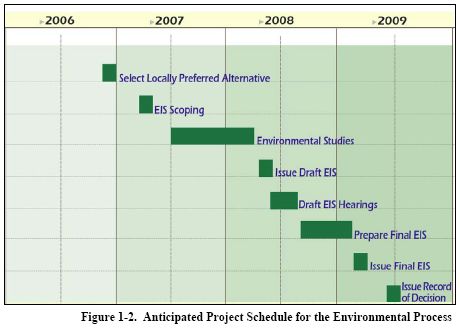 to arrive at the station — let alone left it:
This project schedule is from the the new Scoping Information Package issued May 15. We are in the middle of what is called EIS Scoping.
When that is complete and we have submitted our comments, and been responded to, then the City will apply to go into the next phase of the process called Preliminary Engineering.
This will be the first time that the Federal Transit Administration (FTA) will take a hard look at the city's projections. If FTA is satisfied with the projections then the Environmental Studies begin, which, as shown, will take about a year. That puts us at about May 2008 when the Draft Environmental Impact Statement (DEIS) is to be issued.
The city then says that within a year it will get a Record of Decision (ROD), which will grant the City the federal funding. However, this is a very ambitious schedule. Last time, it took 2½ years for us just to get from the DEIS being issued to the City Council turning the whole thing down.
Far from being a done deal, the City Council has yet to decide whether the "fixed guideway" is to be bus or rail, let alone made the major decision that is at least two years off — whether or not to spend the money. This is when we will sort out the men from the boys and, by the way, there is an election before then.
This turkey has yet to arrive at the station, let alone left it. READ SCOPING
March 30, 2007.
Channel 8 replaces video and reportage:
The video that Channel had up yesterday timed out and they replaced it with this one that is in many ways much better. VIEW CHANNEL 8
Honolulu Rotary applauds Dr. Prevedouros' talk:
Last Tuesday, March 20th, Panos was the lunchtime speaker for Honolulu Rotary, a 250 strong rotary club. He discussed our opposition to rail and for HOT lanes and the Rotary Magazine has published the following afterwards:
"Entertaining, thought provoking, educational, illuminating and frustrating
were some of the comments made at our table upon the completion of Dr.
Prevedouros' talk regarding transportation in general and specifically "the
rail."
In the Q and A, Linda Coble asked the $64
question: "What can we do to stop the train?" The question drew a loud round of
applause - which speaks volumes. The answer was, get involved, contact your
elected officials and media, as well as show up on march 28 at Kapolei Hale at
6:30 p.m. and McKinley High School on March 29 at 5:00 p.m. Let your voice be
heard so we don't get bankrupt and run over by a train that only a few will use
at a cost of $6.5 billion - yes, $6.5 billion. One could fix a lot of potholes
with that kind of dough. At a vote of members at our table - it was unanimously
agreed that the present rail system being pushed by Mayor Mufi was "a lunatic
idea that must be stopped at all costs." For more information go to http://www.eng.hawaii.edu/~panos/ " READ MORE
Dennis Callan produces short video of protest rally:
Dennis took his video camera out on the street on Wednesday during our protest rally and produced this excellent video with interviews with some of the participants. WATCH VIDEO
March 28, 2007.
Star-Bulletin covers the rally — Advertiser silent:
Good coverage by the Star-Bulletin in this afternoon's paper. READ MORE Unfortunately, there was absolutely no mention of our protest rally. or the reasons for it, in today's Advertiser despite coverage in the Star Bulletin and all of the four TV station that cover local news.
March 28, 2007.
Excellent turnout at our protest rally today:
We had an excellent turnout this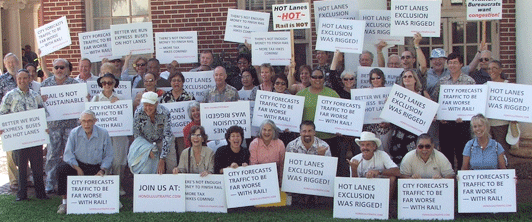 morning at City Hall to protest the exclusion of HOT Lanes (Managed Lanes) Alternative. There were 50, or more, of us there all holding signs telling voters that the HOT lanes exclusion was rigged and that the City is not telling the public that traffic congestion will be far worse with rail than it is today.
We had coverage on all four TV news stations and we'll see what coverage we get with the other news media tomorrow.
For full details of the reasons for our protest, click here to READ MORE And here for TV news coverage CHANNEL 2 TV (click on picture) from one of the four stations that covered us.
March 24, 2007.
U.S. Department of Transportation on congestion pricing:
The USDOT says that congestion pricing is the single most viable approach to reducing congestion and has achieved positive results both here in the U.S. and around the world. Just by reducing peak period travelers by 3-8%, it can reduce delays by up to 50%. READ MORE
Honolulu slips to 57th largest metro area:
The Demografia website has consolidated the 2006 Census data for U.S. metro areas and it shows that Honolulu has slipped to 57th among the nation's metro areas. During the 2000-2006 period, Honolulu grew at less than half the rate of other Metro Areas Honolulu's size.
And a reminder: There are more metro areas larger than Honolulu without rail than those that have rail. READ MORE
March 22, 2007.
FTA and City issue new Notice of Intent
The FTA and City on March 15 issued a new Notice of
Intent to prepare an Environmental Impact Statement (EIS) for the “fixed guideway”
in the Leeward Corridor under the National Environmental Protection Act (NEPA) —
again.
They did this the first time in December
2005 and since they have not subsequently rescinded it we must have been operating
under the same NEPA rules all along — or have we? Unfortunately we cannot get a
straight answer on that issue. This is what is known as “public involvement.”
The main difference between the two
documents is that they have now excluded the Managed Lanes Alternative (MLA aka HOT
lanes) on the grounds, one assumes, that the MLA in the City’s Alternatives
Analysis was “previously studied and eliminated for good cause.”
We have protested to FTA that the MLA
study was eliminated for political cause, not a “good cause."
The construction cost forecast by
Parsons Brinckerhoff (PB) was seven times the cost the Tampa Expressway (a
similar facility). The “soft costs” alone (architects, PB, and sundry
consultants) for the MLA was forecast to be 30 percent higher than the total
cost to construct the Tampa Expressway.
PB and the City also forecast that the
MLA would need 50 percent more buses than the low cost alternative yet get only
five percent more bus riders. And so on …. READ PROTEST
Anyway, at the same time the City issued
a Scoping Information Package, which outlines for us the anticipated schedule
of events
They will hold Scoping hearings for “insiders”
on Wednesday March 28 from 10:00-12:00 am at the City Auditorium adjacent to
City Hall on the
You will then have until April 13 to
submit written comments to the City. The City will then respond to them.
The City and PB will then continue with
the EIS which will issue in Draft form about April 2008. There will then be hearings
and a comment period through about August 2008, and then they will prepare the
Final EIS and issue that in about March 2009. They then hope that the FTA will
issue a Record of Decision (ROD) in June 2009. READ SCOPING
Eighteen months from now we will be
embroiled in elections for Councilmembers and the Mayor and the most of the
Legislature. At that point the project will be imminent and should add some
interest to the races.
A few months after the 2008 election, the
City Council will have to vote to actually spend the money and this will be the
interesting event. Anyway, it is not a done deal by a long way.
March 11, 2007.
Memminger on Hannemann the Hun:
You must read the Star-Bulletin's Charles Memminger column for today on Mufi. Excerpt:
"He's figured out Fasi's secret to being mayor of an island city and county: If they don't like what I do, they can leave. They yell, scream, cry, pull their hair out, beat themselves with branches (and that's just in the City Council subcommittees). They write letters to the editors. They pester my staff. They burn effigies of me on the lawn of Honolulu Hale. BUT THEY DON'T LEAVE! HAHAHAHA! Once you realize you can raise fees, taxes, charges, rates, costs, dues, levies and tolls and the entire population of Oahu doesn't decamp to Las Vegas or Arizona, you have become MAYOR OF THE WORLD! HAHAHAHA!"
Because people don't leave. Raise the sales tax? They stay. Raise sewer fees? They stay. Raise garbage collection charges? They stay. Impose a $10 puppy tax? They stay. Make them pay for a rail system that no person alive today will ever ride on? They stay. It's a beautiful thing." READ MORE
Star-Bulletin: George Will on traffic congestion:
Nationally syndicated columnist George Will talks about the cost of traffic congestion and quotes Mary Peters, USDOT Secretary and Reason Foundation''s Ted Balaker and Sam Staley and their book, The Road More Traveled (in our view a must read). Excerpt from Will's column:
"In the 13 largest cities, drivers are stuck in traffic the equivalent of nearly eight work days. Congestion's immediate and indirect economic costs -- not including lost serenity, family time and civic engagement -- just begin with fuel and wear and tear on vehicles.
Innovative "just in time" delivery practices have enabled businesses to control inventories, thereby modulating business cycles. Congestion, however, is forcing supply-chain managers to hold larger inventories or build more distribution centers, thereby increasing the transportation and logistics components of GDP." READ MORE
Road funding takes a toll:
When Panos Prevedouros and Cliff Slater returned from their week in DC at the International PPP Conference they told us that it was astonishing to learn of all the incredible changes occurring in highway financing worldwide, including the U.S.; it is all about PPP, tollways and HOT lanes.
Florida has not built a non-tolled freeway in the last 20 years. Add to that the news that Texas alone has plans for 4,000 miles of tollways and it confirms the trend. READ MORE
KEN ORSKI the highly respected publisher of Innovation Briefs, said at a recent conference, "Looking at the rapid pace of change in attitudes toward tolling, it is quite conceivable that by the end of this decade, toll facilities will become the primary means of expanding highway capacity." READ MORE
March 8, 2007.
Thought from the Public Private Partnership Summit in DC:
One of the presenters at the PPP Summit put rail and tollways in perspective this way. If you build a tollway and a rail line and have an auction, here's what happens. For the tollway you auction it off to the highest bidder, but the rail line is auctioned off to the one offering to run it at the lowest subsidy. That's one way of looking at it.
March 6, 2007.
WSJ: "They are all 'F' trains":
Today's Wall Street Journal details the financial state of New York City's rail transit lines. The say, "much of the subway spending is not for new projects but for core maintenance and replacement of existing assets: cars and tracks, for example. Nearly half of that work is funded with debt, almost twice as much as in the '80s and early '90s. As a result, within three years more than 21% of subway revenues will go directly toward paying interest and principal -- twice as much, percentage-wise, as just a couple of years ago. And it will only get worse: As debt service consumes more of the subway budget, fewer dollars will be available for operating tasks like cleaning stations." FULL STORY
March 3, 2007.
Train noise:
Courtesy of Panos Prevedouros and Peter Kay we now have a sound clip of the DC Metro. Unfortunately,we do not have the wonderful sound that trains make as they go around sharp curves, that gorgeous squeal, such as during the transition from Ward Avenue to Kona Street or Kapiolani onto University. Nevertheless, this will do. LISTEN TO TRAIN
Dems and GOP cut earmarks:
"The White House is instructing federal agencies to ignore earmarks that are not written into law, in keeping with a prohibition on pet projects Democrats included in a sweeping spending measure Congress approved Wednesday.In a memo sent to all agency heads Thursday, Office of Management and Budget Director Rob Portman wrote they should only honor earmarks contained in statute or otherwise subjected to rigorous review. The memo also makes clear agencies should not fund earmarks based solely on lobbying from lawmakers or other interested parties.
In the $463.5 billion fiscal 2007 full-year funding bill President Bush signed into law Thursday, Democrats removed about 9,300 earmarks that had been slated for approval under the regular fiscal 2007 spending bills, many simply listed in reports accompanying the bills. The measure contains no new earmarks, as well as a provision stipulating that earmarks contained in fiscal 2006 reports "shall have no legal effect."
Spending bills typically include earmarks in the reports as recommendations, meaning they have no force of law. But agencies are often guided by such congressional directives, in part because of the influence on their budgets wielded by powerful lawmakers." Source: GOVEX.COM — The daily news service of Government Executive magazine.
Finally, the City's response to our Scoping comments:
After complaining, we recently received from the City a response to our Scoping comments. It was dated June 20, 2006. It seems that we are the only one to get a response from what we have been able to tell. You have to complain to get them to follow the process, it seems.
Among other things their response says, "Projects with the purpose of providing roadway mobility for automobiles and commercial vehicles are outside of the authorization of Act 247; therefore, they will not be considered for the Honolulu High-Capacity Transit Corridor Project." In short, the City intends to do nothing about traffic congestion because the Legislature will not let them. This seems to us to be a variant of, "The Devil made me do it." READ RESPONSE
March
2, 2007.
Panos Prevedouros Powerpoint PPP Preview:
Now say it quickly. Seriously, Dr. Prevedouros has been kind enough to provide us all with a Powerpoint summary of the current situation regarding Public Private Partnerships, much of it gleaned from his and Cliff Slater's attendance at the International PPP Conference in Washington DC last week. VIEW POWERPOINT
USDOT lists all congestion pricing projects:
We have been discussing HOT lanes for some time using the examples of the San Diego and Orange County HOT lanes -- both in California. This USDOT current list of existing and planned projects now totals 55 facilities in 13 states. What a remarkable and swift advance for a new idea that was only conceived in 1992. It makes interesting reading to review this list. READ MORE
March
1, 2007.
Pritchett and Adair chip in on the rail discussion:
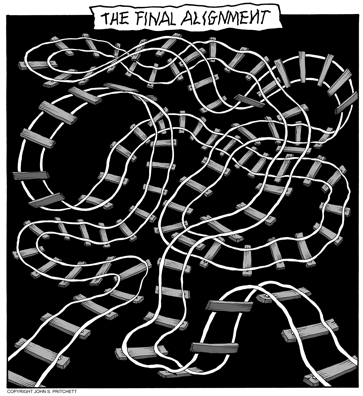
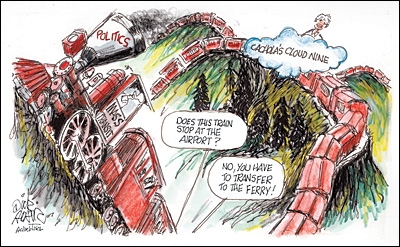
When the cartoonists start poking fun at it, and Tuesday's Council vote was 5-4 in favor, down from 7-2, do you get the feeling that this may be rail transit in its early death throes?
February
8, 2007.
The tipping point has arrived:
There has been a great deal of conjecture about the tipping point where traffic congestion reduction becomes the most important consideration and not just the improvement of public transportation. Dale Evans has researched a number of articles from around the country and from that we can only conclude that the tipping point has indeed arrived. From now on, look for highways to take precedence. READ MORE
Welcome to these new members:
Welcome to the latest additions to our roster of those willing to stand up and be counted:
John L. McDermott Paul Vierling Jack Schneider
Ned Smith Rick Moss Alan S. Lloyd
Malia Zimmerman James Roumasset Bill Green
Click on the "Who we are" button for other members.
WSJ: Bush plays traffic cop in today's budget request:
The Wall Street Journal said today that "In his annual budget blueprint to be unveiled today, Mr. Bush intends to showcase a highway "congestion initiative," according to White House documents, with grants for state and local governments to experiment with anti-jam strategies." READ MORE
Rail/HOT lanes testimony Olelo schedule:
Dennis Callan has culled out the best testimonies given against the rail line and for HOT lanes
and packaged it into two one-hour programs, which will play according to the following
schedule on Olelo's Channel 54:
2/09/07
|
Fri | 8:30 am |
Part 1 |
2/10/07
|
Sat | 7:00 pm | Part 2 |
2/12/07
|
Mon | 8:00 am | Part 2 |
2/14/07
|
Wed | 6:00 pm | Part 1 |
2/16/07
|
Fri | 3:00 pm | Part 1 |
2/17/07
|
Sat | 6:00 pm | Part 2 |
2/19/07
|
Mon | 5:00 pm | Part 2 |
2/2107
|
Wed | 6:00 pm | Part 1 |
Reminder: The coming rail tax burden vs. other cities:
| Cost in | Metro area | Cost | |
| MSA | millions | population | per |
| 2006$'s | (thous.) | capita | |
| Dallas | $1,067 | 5,222 | $204 |
| Denver | $358 | 2,582 | $139 |
| Portland | $1,643 | 2,265 | $725 |
| Sacramento | $307 | 1,797 | $171 |
| Salt Lake City | $376 | 1,334 | $282 |
| St. Louis | $464 | 2,604 | $178 |
| Pittsburgh | $1,051 | 2,571 | $409 |
| Honolulu |
$6,400 |
980 | $6,531 |
Sources: U.S. General Accounting Office http://www.gao.gov/new.items/d01984.pdf for cost data for the top six rail cities with population data from FHWA's msacomparison.xls Pittsburgh data : Pickrell, Don H. Urban Rail Transit Projects: Forecast Versus Actual Ridership and Costs. U.S. Dept. of Transportation. October 1990. U.S. CPI change 2000-2006 is +17.3 percent see State Data Book 2005. For Honolulu the City forecasts $4.6 billion while we believe it will more likely be $6.4 billion see our December 7 entry.
February
1, 2007.
FHWA rebukes Portland and it's music to our ears:
The FHWA critiqued the first draft of the Portland Regional Transportation Plan and in so doing asked, "Where's the beef?" They said, among other things, "The plan should allow for highway expansion as a viable alternate. The transportation solution for a large and vibrant metropolitan region like Metro should include additional highway capacity options along with maximizing use of the existing system and land use choices. The plan should acknowledge that automobiles are the preferred mode of transport by the citizens of Portland....they vote with their cars everyday." This is wonderful stuff. Is it generated by the new DOT policy on reducing congestion? READ MORE Of course, it begs the question: Why is FHWA not critiquing the Oahu MPO draft ORTP?
O'Toole: Why planners always get it wrong:
Randal O'Toole has a new website called the anti-planner. Here's the kind of material you find:
"The Incentive Problem: Why Planners Always Get It Wrong in Why Planning Fails, Regional planning Government planning fails because planners face the wrong incentives. Instead of being rewarded for doing good things for their communities, they are rewarded mainly for pleasing other planners. This incestuous system is a recipe for failure. In a previous post, I listed seven reasons why government planning — that is, long-range, comprehensive planning that often regulates other people’s property — cannot work. I’ve discussed four reasons in detail, and now it is time to address reason number 5: the Incentive Problem." READ MORE
January 28, 2007.
Houston bus riders get short changed by rail:
This article from the Houston Chronicle details the typical problems bus riders face after rail is built and transit officials need to increase rail ridership. They organize bus routes to accomplish it and this harms regular bus riders. Here's how: READ MORE
The ongoing war against the automobile:
Some time ago we reprinted an excerpt from the 1974 book, War against the automobile, in which the author dealt with all the enemies of the automobile and why. Here's the excerpt: READ MORE
Then Professor James Dunn of Rutgers wrote a 1988 book titled Driving Forces, published by the Brookings Institute, the first chapter of which deals with the current enemies of the automobile. This chapter is fortunately available to us online and is must reading. READ MORE
Professor Dunn has also written a recent essay, Mobility Contested: Ethical Challenges for Planners, Administrators and Policy Analysts. This is also essential reading. He discusses the pervasive influence of what he calls "the anti-auto vanguard." Quote:
"This
vanguard of enemies of the automobile rejects the conventional idea that
the automobile-highway system is a hugely successful means of personal
mobility with serious but manageable negative side effects. Rather, it
sees the auto as an out-of-control cancer on the planet whose very existence
now amounts to an "evil" which must be severely restricted.
The vanguard sees it as their moral duty to implement as much of their
anti-auto agenda as they can. In the
In a democracy, the dilemma is how to reconcile the strong desire hundreds of millions of citizen/motorists have for the individual empowerment that cars provide with a small but intense and very active minority's strongly-held belief that, for the common good, people need to be discouraged, even prevented, from choosing auto-mobility."
Subsequently he discusses planning bias among this vanguard. Quote:
"In recommending a choice among public investments in transportation projects ranging from a highway improvement to a rail transit system, do the anti-auto beliefs make planners more likely to overestimate the number of future transit riders and underestimate the costs of constructing the transit system? A substantial amount of evidence has accumulated that this kind of pro-rail project error is widespread in transportation project planning. Is there an ethical transgression that must be ascribed to public employees who participate in a process which deliberately overstates the benefits and underestimates the costs of transportation choices? Is this persistent skewing of data in planning studies simply bureaucratic politics as usual or does it constitute a rather specific type of ethical lapse provoked and legitimized by the moral certitude inherent in the anti-auto vanguard position?"
Later, he describes how Dr. Don Pickrell, now senior economist at USDOT's Volpe Center, was removed from any transit responsibilities after he examined "the political and bureaucratic factors that he believed may have led to the systematic overestimation of ridership and underestimation of costs. He suggested that local elected officials get committed to a project and communicate this commitment to their planning staffs. The planners, in turn, produce favorable numbers in order to have a better chance to compete for limited federal subsidy dollars. They organize public hearings and public relations campaigns in which pro-transit groups and anti-auto groups are mobilized to show public demand for the projects. If federal officials are still skeptical, local leaders can often rely on their congressional delegation's political influence to legislatively "earmark" the funds for the new projects. It is a process in which mayors, planning staffs, transit officials, transit unions, and construction firms essentially conspired to have the federal government finance their "Desire Named Streetcar." READ MORE
EDITOR: We just wanted you all to know that Honolulu is not alone in all this.
January 26, 2007.
Latest news on "Thoughts on the advantage of HOT lanes":
No sooner did we post the item below than we find a new analysis by the Federal Highways Administration that puts the throughput of vehicles on the most congested freeways at one half that of priced lanes. This means that a HOT lane is worth two congested lanes for vehicle throughput. This is the kind of correction we like to make. READ MORE
January
24, 2007.
Thoughts on the advantage of HOT lanes:
One factor that is often overlooked is that during the rush hour, a two-lane HOT lanes [Managed Lanes] is the equivalent of three lanes of regular H-1 freeway. Here's how it works: During rush hour traffic moves at around 20 mph and at that speed the throughput of vehicles is about 1300-1400 per lane per hour.
Variable tolls allow us to carefully manage the traffic so that the HOT lanes are full but uncongested. At free flowing speeds the throughput of vehicles is in excess of 2000 vehicles per hour, or 50 percent greater than the regular freeway lanes. Thus, two HOT lanes convey the same amount of traffic as three regular freeway lanes.
This leads us to a discussion point we should have with those who are opposed to HOT lanes and would never use them. This person would benefit from a 25 percent reduction in traffic on the regular freeway. It is also not going to cost them anything, since the only local funding will be provided by those who pay to use the HOT lanes. And while they say they will never use them, it is a rare person who does not occasionally have an urgent reason to need a quick way of getting to an appointment of some kind and the HOT lanes will always be there for such emergencies.
January
16, 2007.
REPEAT: OMPO survey shows great public support for HOT lanes:
Certain items need to be repeated; here's one that we ran on March 15, 2006:
"OMPO has just release the results of a federally funded telephone survey of a random sample of 400 Oahu residents on transportation issues. All questions were designed by OMPO and its consultant team in consultation with Ward Research.
Among the more interesting questions asked were:
Q4a.
Would you support construction of an elevated high-occupancy highway for
carpools, vanpools, and buses from ‘Ewa to downtown along parts of Kamehameha
Highway and H-1?
Overall
69% for v. 25% opposed. Among Ewa/Leeward residents, 78% for.
Q4b.
If such a project were constructed, would you support making it a high-occupancy
toll facility, called a HOT facility?This
facility would allow solo drivers to use it if they pay a toll and if
the lanes are not fully utilized by high-occupancy vehicles.
Overall
67% for v. 28% opposed. Among Ewa/Leeward residents, 73% for.
Q4c.
Would you support construction of such a project if the tolls generated
were not sufficient to cover the cost and it would require increased taxes?
Overall
29% for v. 66% opposed.
Q4e.
What is the most you would pay to use HOT lanes if it would save you 15
minutes in travel time? Would you pay...?
Overall
8% would pay $4 or more, Among Leeward/Ewa residents 20%.
This is a far less biased survey than the one OMPO took in November 2004. However, as we said then, the voters are generally unaware of the costs or benefits of the principal alternatives — rail transit or HOT lanes. Therefore, questions about taxes that do not quantify the tax impact on taxpayers,or the congestion benefits/disbenefits, cannot elicit accurate responses. Second, specifying 15 minutes as the time savings for HOT lanes is unrealistic; it is likely to be more like 30 minutes,or greater, during the rush hour.
An interesting general result of the survey is that it shows great public support for new highway facilities, such as HOT lanes and widening highways, particularly H-1 from Pearl City to Kahala. There is no support for bikeways. Clearly, our elected officials are out of sync with their constituents because the officials keep opting for bikeways and rejecting building highways whereas the voters think exactly the opposite. READ MORE
January
15, 2007.
The energy use discussion:
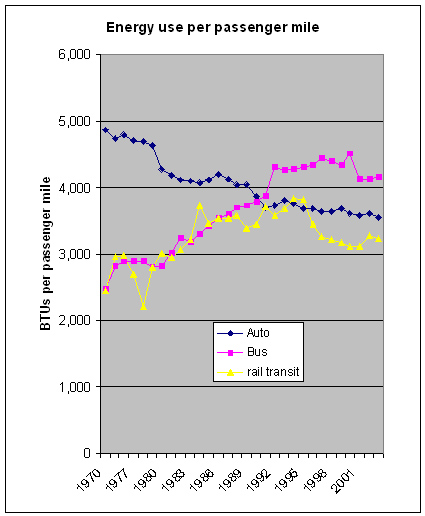
Below is a chart showing the energy use per passenger mile for automobiles, buses and rail transit from the U.S. Dept. of Energy Transportation Energy Data Book, 2006. pp. 2-13/14.
 Notice
that automobiles show a steady downward trend in energy use while buses
and rail transit have trended upwards albeit with certain times of decline.
Note also that auto fuel use has declined to where it is now less per
passenger mile than buses while rail transit is only nine percent less
than autos. With the advent of hybrid cars and buses we may expect autos
and buses to continue to decline while rail transit stays fairly flat.
It is therefore only a matter of time before automobiles will use less
energy per passenger mile than rail transit. While the trend for vanpools
is not given, they do show that energy use by vanpools is 1,400 BTUs per
passenger mile, which is 60 percent less than rail transit.
Notice
that automobiles show a steady downward trend in energy use while buses
and rail transit have trended upwards albeit with certain times of decline.
Note also that auto fuel use has declined to where it is now less per
passenger mile than buses while rail transit is only nine percent less
than autos. With the advent of hybrid cars and buses we may expect autos
and buses to continue to decline while rail transit stays fairly flat.
It is therefore only a matter of time before automobiles will use less
energy per passenger mile than rail transit. While the trend for vanpools
is not given, they do show that energy use by vanpools is 1,400 BTUs per
passenger mile, which is 60 percent less than rail transit.
Some may find these data counter-intuitive especially listening to all the hype that is out in the media. However, except within dense urban centers, trains trend to run empty on the runs back out to the suburbs, and run all day regardless of demand. Undoubtedly, a full train uses less energy per passenger than a single-occupant vehicle (SOV), however, that is not how they are operated. On the other hand, autos and vanpools travel from their point of origin to their destination and park. They do not run around aimlessly as if costs (or energy) do not matter.
MOS discussed at Council Transportation Committee Thursday:
Little specific was discussed at the Council's Transportation Committee yesterday. The new chair, Councilmember Garcia took over. The DTS people talked about the MOS but few specifics only that it would have revolve about the Navy Drum Site at Waiau because that was one of two that were available anywhere on the island and they were close together.
A real life situation of a typical change in bus routes to feed rail:
We
have often mentioned the fact that with the advent of rail in a community,
bus routes are changed to feed the rail line much to the surprise of local
commuters. The recent opening of the
January
11, 2007
Transportation Committee meets today on MOS:
The Council Transportation Committee meets today at 1:00 pm in the Committee Room to hear from the Administration on options for the Minimum Operating Segment (MOS). READ MORE
We should oppose the adoption of any MOS unless it is accompanied by a fully fleshed out financial plan for the entire 28-mile line that the Mayor is intent on building. What we know from rail transit history is that once a segment of a rail line is built, the full rail line is always completed. The financial danger that our community faces is that we will only see a financial plan for the MOS, which will appear adequate but when the plan is developed for the full line it will require a massive tax increase. Using a total cost of $6.4 billion, we calculate that it will require a 40 percent hike in Honolulu's property taxes, or the equivalent in some other taxes or 'fees' in order to retire the debt by 2042 when major replacement and refurbishing costs will be incurred. SEE CASH FLOW
January
10, 2007
Time to remind ourselves who voted for the rail tax:
The vote for the rail tax was not overwhelming: the vote was 32-19 with 11 Democrats voting AGAINST and two Republicans voting FOR. Of the Neighbor Island Democrats, 12 voted FOR; it would be interesting to know how they would vote today since there has been so much opposition to the tax in the Neighbor Islands. READ MORE
January
9, 2007
Small Business Hawaii Convention Wednesday; Slater's up first:
The annual Small Business Hawaii Convention is tomorrow, Wednesday, January 10, starting at 8:00 am with their usual great program. Legislators will discuss what is upcoming in the Legislature later this month and Administration officials will talk about the changes they intend to make and the legislation they will offer.
David Tyreman, author of "WORLD FAMOUS: The 4-Steps Between You and a World Compelled to do Business With You," is the keynote speaker. Wally "Famous" Amos, of Chip n' Cookie will be talking on marketing, and Cliff Slater, will talk first at 8:30 am on "Rail transit: From those wonderful folks who brought you Aloha Stadium." For the full program: READ MORE
January
7, 2007
Check out Public television on Monday at 7:30 pm:
Pearl Johnson, head of the League of Women Voters Planning Committee, Professor Panos Prevedouros, and Cliff Slater appear Monday evening, January 8, at 7:30 pm on Channel 10's Island Insights, with Dan Boylan, to discuss the mass transit issue.
It is a good idea to check our "quotes" tab from time to time:
We could not afford a $2 billion light rail in 2000 but we can afford a $5 billion one in 2006? Makes you think.
January
2, 2007
Every transportation official should read "The road more traveled":
On
second thoughts, we should all read it. The full title is,The
road more traveled: Why the congestion crisis matters more than you think,
and what we can do about it by
January
1, 2007
Happy New Year! And let's start it off with a good laugh:
The U.S Dept. of Transportation has the following on its website in answer to the question:
What are the indicators of an effective public involvement process?
Answer: "A good indicator of an effective public involvement process is a well informed public which feels it has opportunities to contribute input into transportation decisionmaking processes through a broad array of involvement opportunities at all stages of decisionmaking.
In contrast, an ineffective process is one that relies on one or two public meetings or hearings to obtain input immediately prior to decisionmaking on developed draft plans and programs. Public meetings that are well attended, frequent news coverage on transportation issues, public forums where a broad representation of diverse interests is in attendance, and plans, TIPS, MIS alternatives, and project designs which reflect an understanding and consideration of public input are all indicators that the public involvement process is effective." READ MORE
COMMENT: While USDOT officials may have good intentions, we wonder whether they ever get out to the real world of "public involvement" where the objective appears to be to so bore the attendees that they will leave the meeting early. At one of these meetings, the Star-Bulletin quoted Bob Loy, director of environmental programs for the Outdoor Circle as saying, "We are uncomfortable that it is not the kind of process that would really allow for a good free public conversation about this issue and how it should be handled. It seems to have been designed in a way to limit public interaction and the ability for the public to create any kind of synergistic conversation that could result in a community conversation."